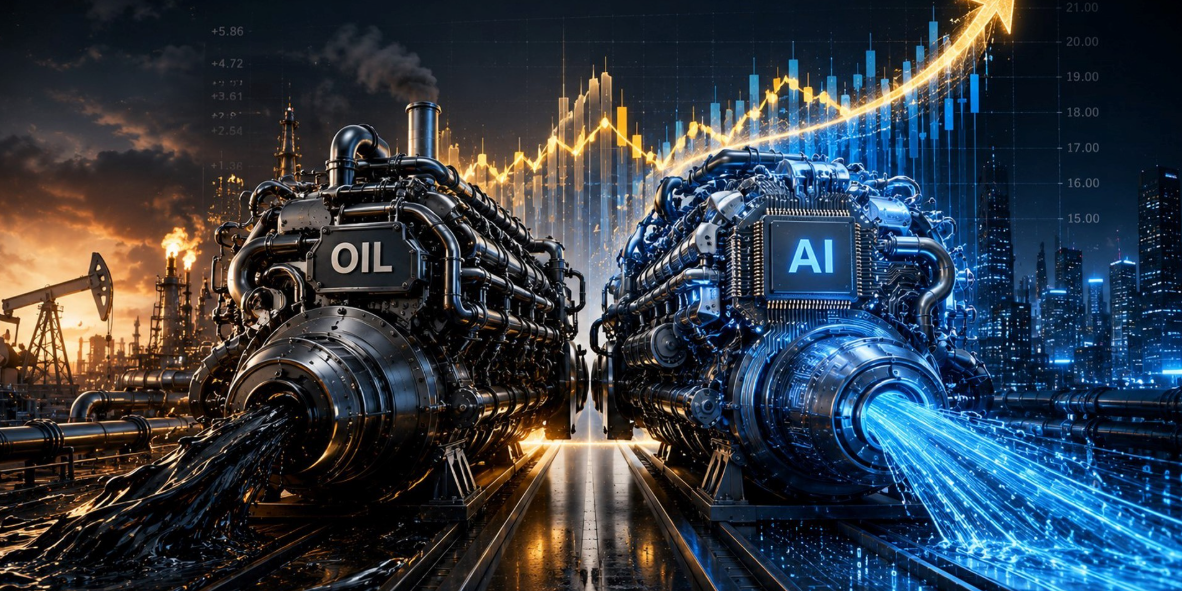
The S&P 500, Nasdaq and MSCI World once again powered to new highs this week, closing 1.2%, 2.2%, and 1% higher, respectively, at the time of writing. The indices are on track for their best monthly closes of the year. Risk-on sentiment prevailed as investors reacted to this week’s oil price decline to $91.34 a barrel and placed big bets on continued exponential growth from the Artificial Intelligence (AI) theme.
Hopes for an extension of the ceasefire between Iran and the US pulled crude prices and oil futures sharply lower. Reports late on Thursday suggested that US and Iranian officials have tentatively agreed to reopen the Strait of Hormuz and start 60 more days of negotiation about Iran’s nuclear programme. US President Donald Trump had not signed off on a deal at the time of writing.
Lower oil prices should relieve inflationary pressures, mitigate against the risk of interest rate hikes and leave consumers with more money in their pockets for discretionary spending. All of these factors would be more positive for equities than continued disruption in global energy markets that forces consumers to cut spending and incentivises investors to place their holdings into cash rather than stocks.
But it is also important to note that most of the gains in equities this year and for the week have been driven by AI-related plays. Investors continue to embrace the conviction that AI represents a genuinely revolutionary shift comparable to the arrival of the internet. Headlines about dramatic advances in new model releases and evidence of enterprise adoption are helping to fuel optimism about the AI theme.
Outside Nvidia, most members of the “Magnificent Seven” posted gains this week. Meta, Apple and Amazon performed especially strongly. In line with our article about the “Secret Seven” last week, a lot of the action occurred outside the “Magnificent Seven”. South Korean memory chipmaker SK Hynix and its US counterpart, Micron Technology, both joined the elite trillion-dollar market capitalisation club this week.
The two computer-component giants join a club of fourteen members, including Samsung (also a recent entrant), Berkshire Hathaway, Saudi Aramco, Meta, Apple, Amazon, Microsoft, Alphabet, Broadcom, TSMC, Tesla and Nvidia. Outside Berkshire Hathaway and Saudi Aramco, this club is almost entirely composed of technology and AI plays.
Continued growth in tech companies suggests that investors remain confident that AI will restructure how companies work, consumers behave, and banks allocate capital in the years to come. Unlike the dotcom era, investors are confident that today’s tech plays are supported by massive cash flows, revenue growth and strong market dominance.
While there are concerns that some companies’ valuations are stretched and that they face a long road to realising returns from their massive capital investments, price-to-earnings ratios are not extravagant. While market indexes like the wider S&P 500 average a P/E of roughly 21, the “Magnificent Seven” have multiples closer to 28. This is a far cry from the dotcom era when the Nasdaq composite hit a P/E ratio of over 175. Strong earnings from Big Tech companies for the first quarter reinforced investors’ comfort that the AI megatrend is supported by real-world earnings and diverse revenue bases.
Yet there are also risks worth acknowledging: an oil-related inflation shock further down the line cannot be ruled out. The AI-heavy tilt of global indices and the concentration of gains in a few mega-cap stocks means portfolios are exposed if sentiment towards the sector shifts. For now, however, bytes and barrels have underpinned healthy gains across global equity portfolios, and the structural case for both themes remains intact.
“What will differentiate this [ceasefire] from all those that have come before it, is it does seem like there’s at least consensus on the need for a lift-for-lift on the two blockades.”
– Aaron Stein, President of the Foreign Policy Research Institute USA
“Hyperscaler demand is locked and loaded. The [semiconductor and memory] groups are minting money and look like they will continue to do so for years.”
– Charles Lemonides, Founder of hedge fund ValueWorks
“For those of us who have been working that long, the tech rallies we’ve been seeing this year are reminiscent of the boom at the end of the 1990s. It’s also possible that some of the lessons that were learned after the tech bubble burst over 25 years ago will prevent the same thing from happening again.”
– Chris Zaccarelli, Chief Investment Officer for Northlight Asset Management
Global News
- The US and Iran are working towards a 60-day extension of their ceasefire as negotiations continue over Tehran’s nuclear programme, despite both sides accusing each other of breaching elements of the truce. US officials said this week that talks remain active and are progressing in good faith, although differences persist over Iran’s nuclear capabilities, uranium stockpiles and the reopening of the Strait of Hormuz. Vice President JD Vance said only a few outstanding issues remain under negotiation, while any agreement would still require Trump’s approval amid pressure to balance Iran’s demands for sanctions relief against domestic calls for a tougher stance.
- Global markets ended the week on a firmer footing as optimism over ongoing US-Iran negotiations eased concerns about a broader disruption to global energy supplies. Oil prices retreated as investors assessed the prospects for continued diplomatic progress and reduced risks to shipping through the Strait of Hormuz, easing inflation concerns. Asian equities advanced, and US stocks remained near record highs, with the S&P 500 moving closer to a ninth consecutive week of gains. The dollar was also on track for its strongest monthly performance in almost a year.
- Technology stocks led gains in global markets this week as lower oil prices and easing tensions in the Middle East supported investor appetite for risk assets and helped ease inflation concerns. Semiconductor shares helped push the S&P 500 and Nasdaq towards record highs as investors remained optimistic about AI spending and the outlook for major technology companies despite ongoing geopolitical uncertainty.
- Federal Reserve officials this week signalled that US interest rates could remain higher for longer. Governor Lisa Cook said she would support tighter policy if inflation remains persistent, while Vice Chairman Philip Jefferson warned that rising energy prices linked to Middle East tensions may keep inflation risks elevated. New York Fed President John Williams also cautioned that the economic impact of AI and shifting productivity trends remains difficult to assess. The comments added to investor concerns that resilient US growth and higher oil prices may keep inflation above the Fed’s 2% target and delay future rate cuts.
- US consumer sentiment fell to a record low in May, with the University of Michigan’s final index released on Friday dropping 5 points to 44.8 from 49.8 in April, as higher fuel costs linked to the Iran conflict and broader cost-of-living pressures weighed on confidence. The result was below all economists’ forecasts and the preliminary estimate of 48.2, while long-term inflation expectations rose to 3.9% from 3.5% in April, the highest level in seven months. The survey also found that 57% of consumers said high prices were eroding their finances, highlighting growing risks to consumer spending and the broader US economic outlook.
- Chinese authorities this week urged companies to accelerate the adoption of AI while avoiding large-scale job cuts, after major employers warned that AI could eventually replace up to 30% of some white-collar roles. Beijing is encouraging businesses to focus on retraining and reassigning workers rather than reducing headcount as it attempts to balance productivity gains and technological competitiveness with social stability, particularly amid elevated youth unemployment and growing concern about the impact of AI on employment across the economy.
- Nvidia CEO Jensen Huang said on Wednesday the chipmaker plans to invest about $150 billion a year in Taiwan, calling the island the “epicentre” of the AI revolution and predicting it will remain a global technology manufacturing hub for a long time. Speaking at the launch of Nvidia’s planned Taipei headquarters, Huang said construction will begin this year as the company strengthens ties with key suppliers, including TSMC and Foxconn, amid growing global demand for AI infrastructure.
- Surging demand for advanced memory chips pushed South Korea’s SK Hynix and US-based Micron Technology above $1 trillion in market value for the first time this week. SK Hynix rose 9.3% on Wednesday, taking its 12-month gain above 1,000% and making it the third Asian technology company to join the $1 trillion club after TSMC and Samsung Electronics. Micron jumped 19% on Tuesday in its biggest gain since 2011. Both companies have emerged as critical suppliers of high-bandwidth memory used in AI data centres, particularly for systems developed by Nvidia.
- ChangXin Memory Technologies is preparing for what could be China’s largest initial public offering since 2022, as the memory-chip maker seeks funding to expand production and bolster the country’s semiconductor self-sufficiency ambitions amid ongoing US technology restrictions. The planned listing reflects growing investor interest in China’s domestic AI and semiconductor supply chain, with ChangXin emerging as one of the country’s leading producers of DRAM memory chips used in AI systems, smartphones and data centres.
- SpaceX is targeting a valuation of at least $1.8 trillion in its initial public offering, sources indicated on Friday, as Elon Musk’s rocket and AI company nears its debut, potentially making it the largest IPO in history. The company is seeking to raise as much as $75 billion and could begin marketing the offering as early as June. SpaceX generated $18.7 billion in revenue in 2025, up from $14 billion the previous year, while its acquisition of xAI has strengthened its position in the rapidly expanding AI sector.
- Hong Kong overtook Switzerland as the world’s largest cross-border wealth management hub in 2025, according to Boston Consulting Group’s 2026 Global Wealth Report released on Wednesday, highlighting the growing influence of Chinese capital flows and Asia’s expanding role in global private wealth. The report estimated Hong Kong held $2.95 trillion in cross-border wealth, narrowly ahead of Switzerland’s $2.94 trillion, driven by mainland Chinese inflows, strong IPO activity and equity-market gains. Hong Kong and Singapore are expected to grow about 9% a year through 2030, versus 6% for Switzerland.
- As at Thursday’s close the S&P 500 was 1.2% up for the week.
Local News
- The South African Reserve Bank (SARB) raised its benchmark interest rate by 25 basis points to 7.00% on Thursday, marking its first increase since 2023, and warned that further tightening may still be needed if Middle East tensions continue to fuel inflationary pressures. Governor Lesetja Kganyago said policymakers reviewed several scenarios involving higher inflation and weaker growth linked to the conflict, with rising energy prices, geopolitical uncertainty and rand volatility continuing to pose risks to the inflation outlook. The decision lifted the prime lending rate to 10.5% and reinforced expectations that borrowing costs in South Africa could remain higher for longer despite a subdued economic growth outlook.
- South Africa’s annual producer inflation rate accelerated to 4.8% in April from 2.3% in March, driven largely by higher fuel, food and energy-related costs, adding to concerns about persistent price pressures across the economy. Statistics South Africa released the data on Thursday, with the sharp increase reinforcing expectations that inflation risks remain elevated despite weaker domestic growth and adding pressure on SARB to maintain a cautious monetary policy stance.
- Expectations grew this week that South Africa could receive credit-rating upgrades over the next 12 to 18 months after Moody’s Ratings revised the country’s outlook to positive on Friday, citing the government’s commitment to fiscal consolidation and structural reforms. Economists said upgrades could potentially follow the Medium-Term Budget Policy Statement in October, the local elections in November or the February 2027 budget if fiscal improvement and reform momentum are maintained, although weak growth and infrastructure constraints remain key risks.
- Minister of Trade, Industry and Competition, Parks Tau, outlined a renewed industrialisation and investment agenda on Monday aimed at boosting growth, localisation, and export competitiveness as South Africa navigates mounting global economic uncertainty and geopolitical tensions linked to the Middle East conflict. South Africa’s new, forward-looking Industrial Development Strategy is anchored on decarbonisation, diversification and digitalisation, with the government seeking to position South Africa as a leader in the green economy while driving industrial expansion and job creation.
- The Supreme Court of Appeal recently ruled that the South African Revenue Service (SARS) cannot rely on overbroad search-and-seizure warrants, reinforcing that its extensive tax enforcement powers remain subject to strict legal and constitutional limits. The judgment arose from a SARS investigation into a disputed R13.9 million VAT claim, where the court found that the warrant obtained by the revenue service extended beyond the purpose for which it had been requested. The ruling confirmed that unlawfully obtained evidence cannot be used by SARS and serves as an important reminder that tax enforcement powers must be exercised lawfully, proportionately and with appropriate judicial oversight.
- The City of Johannesburg approved sharp increases in electricity, water, sanitation, and property-related tariffs this week as the metro attempts to address mounting financial pressure, infrastructure backlogs, and rising bulk service costs. Business groups and residents warned that the increases could place further strain on households and businesses already facing weak economic conditions, while city officials argued that the adjustments are necessary to stabilise finances, maintain service delivery, and fund critical infrastructure upgrades.
- Netcare expects a dip in patient numbers after the Government Employees Medical Scheme, South Africa’s largest, unexpectedly resigned its benefits earlier this year. The private hospital group said on Monday that this would reduce revenue by about R100 million a month. Netcare also cautioned that the war in the Middle East could slow growth and fuel a global inflationary environment. The group reported a 12% increase in profit for the six months to March on revenue growth of 4.8%, while planning to spend R1.9 billion on expansions over the full year.
- Pick n Pay’s online business reported a second consecutive year of profitability, although turnover growth slowed materially as it chased the scale of market-leading rival Checkers Sixty60. Results for the year to end-February, published on Monday, showed online turnover growth of 32.7%, with asap!, its offering on the Takealot Group-owned Mr D app and PnP Groceries delivering combined growth of 37.6%. Most of the increase was due to revamped online platforms a year earlier.
- As at the time of writing, the rand was 1.4% stronger against the dollar, and the ALSI was 1.5% up for the week.
Sources: Dynasty, Bloomberg, Business Day, Reuters, TechCentral, Moneyweb, ITWeb, IOL, Business Report, Wall Street Journal, etc.