
Many investors are starting to question whether passive index-tracking funds such as passive mutual funds and exchange-traded funds (ETFs) are distorting global equities’ markets. While we acknowledge that passive investing can introduce inefficiencies into the market over time, we believe that the concerns are overstated and that passive vehicles remain extremely efficient building blocks for portfolios.
The key concern critics express about passive investing is that this creates a feedback loop that rewards yesterday’s winners, regardless of whether those companies represent the most attractive investment opportunities on a forward-looking basis. The reason for this is that many index funds weight companies by market value. The more a share price rises, the more money it attracts from passive funds.
Active participants are still driving price discovery in equities markets
Some argue that this reinforces existing trends and potentially contributes to market concentration. Research following the pre-eminence of the AI theme since 2022 has identified evidence of increased concentration, reduced price elasticity and, in certain circumstances, a diminished role for price discovery in heavily indexed securities. Some studies also link rising passive ownership to somewhat higher volatility.
Yet this does not mean that passive investing has broken markets or made them materially inefficient. There is no evidence that passive investing has increased the overall market price level or created a broad “ETF bubble,” directly contradicting one of the more common criticisms of indexation. One reason for this is that active participants are still driving price discovery in equities markets.
While passive mutual funds and ETFs account for more than half of US fund assets, passive vehicles represent a fraction of total market ownership and an even smaller share of economic decision-making within capital markets. Active fund managers, hedge funds, proprietary traders, pension funds, market makers and company insiders are all still analysing businesses, assessing valuations and competing to exploit mispricing.
Prices are set at the margins
It is at the margins where these players operate that prices are set. Think of passive investors as passengers and active investors as drivers. Passengers may fill the seats, but the drivers still choose the route. If passive investing created widespread pricing anomalies, active funds would exploit the opportunities to buy and sell mispriced assets at a profit – attracting capital into active strategies and restoring equilibrium.
Markets are thus still self-correcting, despite the rise of passive strategies. The dominant constituents of global equity indices change over time. Companies that once represented the largest index weights are frequently replaced by new market leaders. This suggests indices are not simply perpetuating the status quo, but reflecting shifts in economic value creation and corporate success. Noteworthy is that although the ‘Magnificent Seven’ have underperformed the S&P 500 year-to-date, a passive instrument that tracks this index has captured the exponentially increased weighting (and hence outsized performance) of semiconductor manufacturers.
The table below illustrates how the 10 largest individual stocks in the this index have changed over the past 40 years.
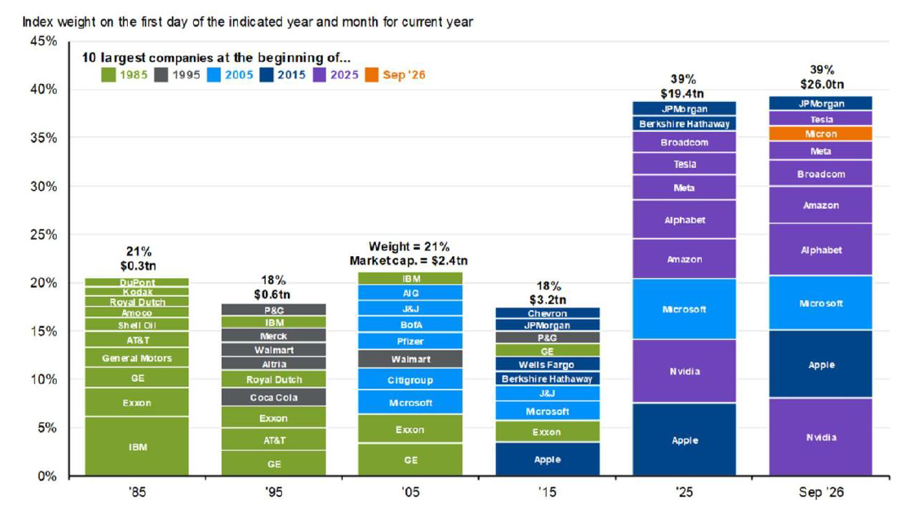
In our view, market concentration is a more immediate concern than market inefficiency. Market-capitalisation-weighted indices naturally allocate increasing amounts of capital to the largest companies. Most of the largest constituents in the indices today benefit from the same underlying themes, including AI, semiconductors, cloud computing and digital infrastructure.
Consequently, investors holding broad passive market-capitalisation-weighted indices may have greater exposure to a relatively narrow group of mega-cap companies than they realise. If the AI bubble bursts, the handful of large-cap stocks driving much of the market could fall sharply and drag most indices down. To address this concern, we are currently assessing the feasibility of including an equally weighted S&P 500 equity index tracker within our house-view global equity fund to reduce concentration risk. (Over the past year, the equally weighted index performed at 10.3% versus the market-cap-weighted index at 15.8%.)
Areas where active managers can still add value
At Dynasty, the useful question is not passive versus active, but which purpose each serves in our clients’ portfolios. Index funds provide an efficient and low-cost means of gaining broad market exposure. Active managers complement these allocations by seeking opportunities in areas that may be underrepresented within indices, overlooked regions (for example, emerging markets) valuation-sensitive opportunities and niche themes.