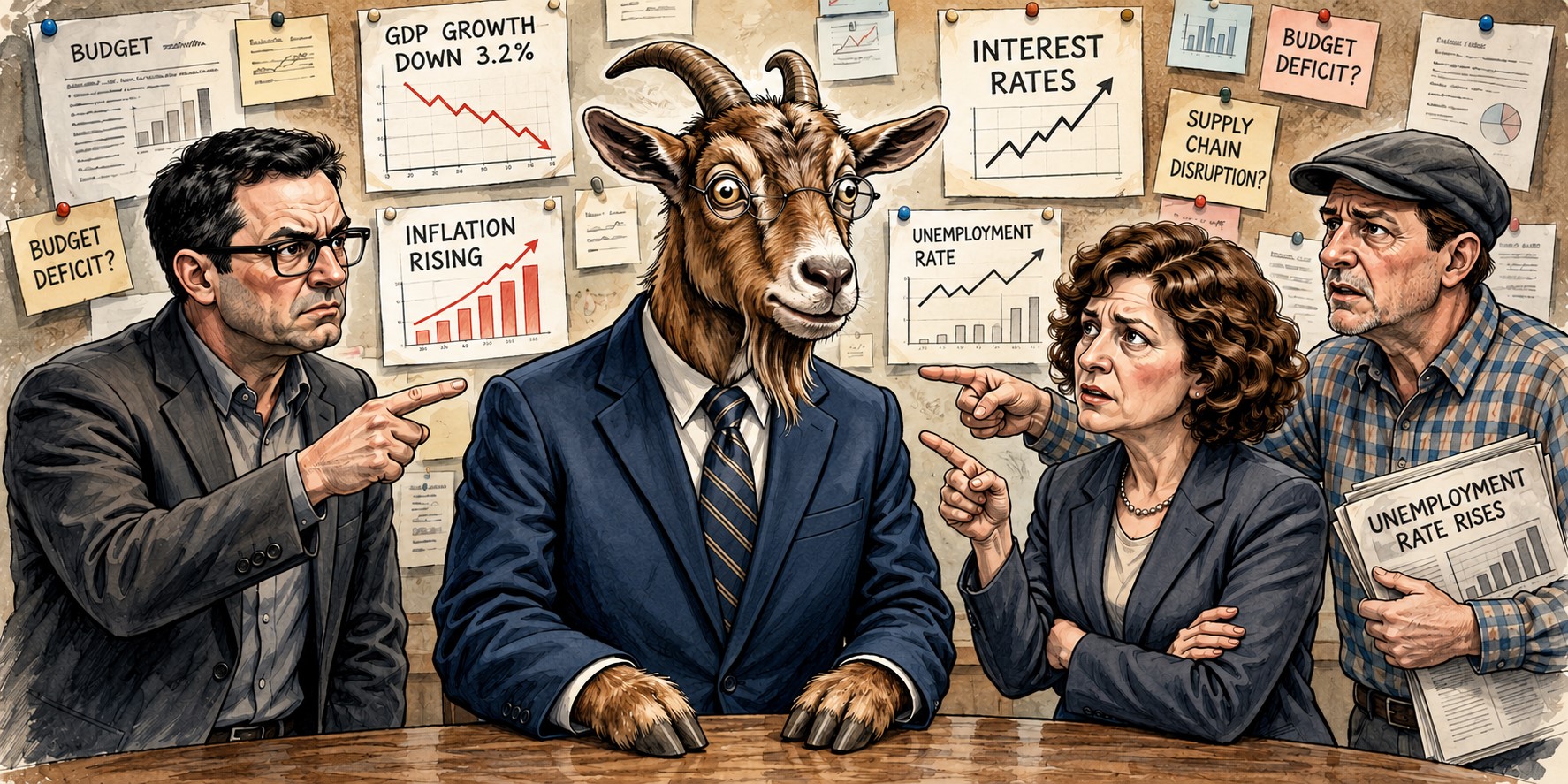
When an economy or the markets are confusing, people will often look for a simple explanation for all of the problems they observe. Some economists use the term ‘scapegoat economics’ as an informal description of the human tendency to pin complex problems with wide-ranging causes on a single convenient culprit.
In recent times, Paul Donovan, Chief Economist at UBS Global Wealth Management, has helped to popularise the idea. He describes how, when societies undergo economic change, people look for explanations and tend to blame specific groups regardless of their relevance. Minorities such as immigrants are frequent targets.
But the concept can be applied far more widely. For example, cheap imports from China and, more recently, AI are often held responsible for job losses that may coincide with other forces, including weak demand, higher borrowing costs, high domestic taxes or company-specific restructuring.
Or inflation might be blamed on corporate greed when supply chain disruptions, oil prices, demand, and numerous other variables are in play. In currency markets, Philippe Bacchetta and Eric van Wincoop describe how traders often use a visible macroeconomic variable as a scapegoat to explain any large currency moves.
The violent riots that have rocked France this week are a recent example of how the dynamic plays out. Prime Minister Sébastien Lecornu has blamed far-left groups for orchestrating the violence, while US President Donald Trump cited out-of-control migration. The protesters blame understaffing and lack of funding in education.
But below the surface, France faces a range of complex economic challenges that are stoking social discontent. French ten-year borrowing costs are hovering near 5%, their highest since 2002. Yet the government faces a demand for levels of social spending that it cannot afford.
Trump, meanwhile, is facing historically high disapproval levels ahead of mid-term elections in the US. He and the Republican Party are trying to shift blame for high inflation to scapegoats such as Ukrainian strikes on Russian refineries and the previous Biden administration. But tariffs and the unpopular war in Iran are more likely to blame.
In South Africa, the commission of inquiry into the rapid depreciation of the rand many years ago was, at the time, a prominent example of scapegoat economics. The commission was appointed in 2002 to investigate rumours of currency manipulation by a handful of large financial institutions following a 40% collapse of the rand in 2001.
The commission found no evidence that South African Reserve Bank (SARB) or National Treasury officials had colluded with market participants. Liquidity, emerging-market contagion and local political sentiment are usually behind wild swings in the value of the rand, but to this day, we occasionally hear allegations that shadowy currency traders are the real villains.
The danger with scapegoating is that it often leads to counterproductive policy responses that fail to address the underlying causes. Then, the search for a new scapegoat begins and the real issue never gets resolved. For example, countries restrict migration to address unemployment or housing shortages but discover this does not solve their problem.
Equities markets can also be impacted by scapegoat economics – blaming a simple villain for a pricing decline. It’s usually not the structural cause that gets blamed, but the most visible or politically convenient target.
When we reach for the simplest explanation, we risk focusing on short-term noise rather than the fundamentals that matter over time.
“The search for a scapegoat is the easiest of all hunting expeditions.”
– Dwight D Eisenhower, 34th US President
Global News
- Cost-of-living pressures and dissatisfaction with public services have fuelled widespread protests across Europe in recent weeks, with unrest intensifying in France, Italy, Belgium and Portugal over the weekend, alongside demonstrations in Spain. The escalating tensions come ahead of elections in several European countries in 2027, raising concerns about political instability and governments’ ability to address economic grievances while managing strained public finances. Prolonged unrest could undermine fiscal reforms, weaken investor confidence and increase pressure on European financial markets.
- Relations between Washington and Kyiv deteriorated further this week following reports that Elon Musk had ordered restrictions on Ukraine’s Starshield (military-grade Starlink) service, disrupting drone operations and exposing its dependence on privately controlled US technology. Trump said on Thursday that access had been restored following his intervention, although Ukrainian officials disputed that the restrictions had been fully lifted.
- Negotiations to reopen the Strait of Hormuz remain deadlocked as Trump threatens renewed strikes after November’s midterm elections. With shipping disruptions pushing Brent crude above $114 a barrel, the impasse continues to threaten global energy supplies and sustain inflationary pressures. Increased Russian exports and planned US emergency reserve releases are unlikely to provide significant relief, with refinery damage and shipping constraints threatening to keep diesel prices elevated into 2027.
- The Fed is increasingly concerned that the AI investment boom is fuelling US inflation, creating a dilemma for monetary policy. (Refer to our opinion piece dated 8 October headed ‘The AI disinflation gambit’). Economists warned on Monday that major technology companies, expected to invest around $1 trillion in AI next year, are largely insulated from higher borrowing costs, leaving smaller businesses, consumers and the housing market to bear the burden of further rate increases. The Fed is expected to hold rates at 3.75% to 4% next week, but further tightening could deepen the divide between AI-driven growth and the broader economy.
- Global technology stocks extended their selloff on Friday as concerns over the cost and profitability of AI investment prompted investors to retreat from the sector. The Nasdaq fell 2.6% on Thursday, and the Philadelphia Semiconductor Index plunged 6.7%, dragging the broader US market lower and spreading losses to Asia. US Treasuries recorded their strongest rally in over a year as investors sought safer assets and scaled back expectations of further Fed tightening.
- Gold fell below $4,000 an ounce on Friday, reaching its lowest level in more than three months after declining almost 3% on Thursday – this despite heightened geopolitical tensions and falling US Treasury yields. The metal is heading for its worst week since June, underscoring its vulnerability to liquidity pressures even amid heightened market uncertainty.
- The US dollar remained under pressure on Friday, hovering near a three-week low as investors reassessed the outlook for US assets. The Japanese yen strengthened to its highest level in more than a month, benefiting from increased demand for traditional safe-haven currencies. The dollar’s weakness despite heightened geopolitical tensions suggests that investors are becoming more selective about US exposure, challenging its traditional safe-haven appeal.
- European corporate earnings are expected to grow 20.7% in the third quarter, according to forecasts released on Tuesday, with growth beginning to spread beyond the energy and technology sectors. Analysts have raised their earnings estimates ahead of reporting season, an unusual sign of confidence. Technology profits are forecast to rise nearly 33%, while industrial companies, banks and consumer staples are also expected to perform well. The improving outlook suggests that European equity opportunities may be broadening beyond the sectors that have driven recent market gains.
- China’s economic growth rebounded to 4.5% in the third quarter, according to National Bureau of Statistics data released on Monday, bringing Beijing’s annual growth target within reach. The recovery was driven by strong exports and AI-related manufacturing, while domestic demand remained weak amid a prolonged property downturn. Industrial production rose 5.5% in September, compared with retail sales growth of just 1.1%, highlighting the imbalance. With its growth target now achievable, Beijing has less incentive to introduce further stimulus, leaving the economy increasingly reliant on exports.
- Meta shares fell sharply on Thursday despite stronger than expected third-quarter results, as investors questioned the mounting cost of its AI expansion. Revenue rose 26%, while its Muse AI assistant attracted more than 10 million users in just six weeks, signalling strong early demand. However, heavy infrastructure investment and legal costs pushed quarterly free cash flow into negative territory for the first time in more than a decade. Meta also announced plans to introduce nonvoting shares to support future growth while preserving CEO Mark Zuckerberg’s control, highlighting the scale of its long-term AI ambitions.
- Chinese AI company DeepSeek has raised approximately $15 billion in one of the country’s largest funding rounds, strengthening its ability to compete with US rivals OpenAI and Anthropic. Tencent and battery manufacturer CATL were among the biggest investors, while the company is preparing for a potential stock market listing. The funding will support the expansion of AI data centres and the development of low-cost, open-source models, which have already put pressure on competitors. The investment underscores China’s growing ambitions in AI and intensifying global competition over technology, infrastructure and pricing.
- Chinese technology giants ByteDance, Alibaba and Tencent have placed orders worth more than $35 billion for over 3 million of Nvidia’s new graphics cards, according to information disclosed on Tuesday. The companies are seeking less powerful chips that comply with US export restrictions as they expand their AI operations. However, Nvidia has warned that customers may receive only 5% to 10% of their requested quantities, as Chinese demand far exceeds planned production. Commercial deliveries are expected to begin in early 2027, with the scale of orders highlighting continued Chinese demand for US AI technology despite trade restrictions.
- Musk endorsed a potential $3.5 trillion merger between SpaceX and Tesla on Tuesday, with both companies appointing independent committees to explore the deal. The combination would unite electric vehicles, robotics, satellite communications, and AI infrastructure, following stronger-than-expected SpaceX earnings, with third-quarter net income reaching $4.4 billion and AI revenue surging nearly tenfold to $7.56 billion. However, the proposal faces significant political and regulatory challenges, particularly concerns over combining SpaceX’s sensitive US defence operations with Tesla’s extensive Chinese manufacturing interests.
- Barclays announced on Thursday that it would cut 5,000 jobs this year, approximately 5% of its workforce, as it expands the use of AI and automation to improve efficiency and reduce costs. Most reductions will affect support functions, including technology roles, as the bank seeks to streamline operations. The announcement accompanied a 12% increase in third-quarter profit, although earnings fell short of expectations following weaker bond-trading revenue. Barclays linked the restructuring to its broader efforts to improve productivity and profitability.
- Berkshire Hathaway shares reached a record high on Thursday, recovering from months of weakness following Warren Buffett’s retirement announcement. Investor confidence has improved under successor Greg Abel, who has resumed share buybacks and begun deploying the conglomerate’s substantial cash reserves through major investments.
- As at Thursday’s close the S&P 500 was 0.05% up for the week.
Local News
- South Africa’s medium-term budget on Wednesday cut the 2026 growth forecast from 1.6% to 1.2%, reflecting the impact of the Iran war and higher energy costs. Despite weaker growth, a R54 billion revenue windfall, supported by higher commodity prices and stronger tax collections, improved the fiscal outlook, with the deficit projected to narrow from 3.9% of GDP in 2026/27 to 2.5% by 2029/30. Government debt stabilised at 78.4% of GDP in 2025/26 and is expected to decline gradually. National Treasury also announced unanimous support from the Government of National Unity for a principle-based fiscal framework, with legislation planned for 2027 to strengthen fiscal discipline, while business leaders urged faster infrastructure reforms to stimulate growth.
- The rand weakened to around R16.45 against the dollar on Thursday as rising oil prices renewed pressure on South Africa’s fuel-importing economy. Despite the setback, the currency has remained relatively resilient, supported by strong commodity export prices and an improving fiscal outlook following Wednesday’s budget, which also boosted government bonds.
- National Treasury allocated an additional R21.8 billion to municipalities over three years in Wednesday’s medium-term budget to address rising service-delivery costs. Metros will receive an additional R13.4 billion from fuel levies, while R3.5 billion will support smart-meter installations to improve revenue collection. Treasury is also preparing a new municipal funding model to address excessive operating costs, weak infrastructure investment, and financial accountability issues.
- South African inflation rose less than expected in September, edging up to 4.5% from 4.4% in August, against forecasts of 4.7%, according to figures released on Wednesday. Despite transport costs surging 10.8%, broader price pressures remained relatively subdued, easing expectations of another interest-rate increase in November. However, inflation is forecast to exceed 5% in the coming months as higher fuel prices feed through into the economy, while potential drought and fertiliser shortages threaten to drive up food costs. SARB remains focused on returning inflation to its 3% target, leaving the outlook for further rate increases uncertain.
- President Cyril Ramaphosa warned on Monday that South Africa must prepare for possible exclusion from the African Growth and Opportunity Act (AGOA) which provides preferential access to the American market. Amid deteriorating relations with Washington, he acknowledged the potentially severe consequences for employment and exports. Trade union Solidarity estimates that 250,000 South African jobs are linked to sectors benefiting from AGOA and has urged the government to protect the country’s trade privileges.
- Plans to open South Africa’s national payments system to fintechs and other non-bank providers were outlined by SARB on Tuesday, aimed at increasing competition and reducing transaction costs. Cash still accounts for 56% of consumer transactions, at an estimated annual economic cost of R88.5 billion. A new regulatory framework is expected by the end of November, ahead of wider non-bank access and a pilot interoperable QR payment system in 2027 to make digital transactions cheaper and more accessible, particularly for small businesses.
- South Africa’s cryptocurrency industry welcomed the government’s decision on Thursday to reconsider proposed regulations governing cross-border crypto transactions, following widespread industry objections. Finance Minister Enoch Godongwana announced on Wednesday that National Treasury would revise the proposals, moving away from prior approval requirements towards oversight focused on legitimate transactions and tax compliance. Industry participants had warned that restrictions on international transfers and stablecoins could drive investment and business activity offshore. A revised draft will be released for further consultation, although the timing and final requirements remain uncertain.
- DRDGold reported a 31% year-on-year increase in September-quarter revenue to R2.95 billion on Wednesday, while operating profit rose 42% to R1.63 billion, supported by higher gold prices and a 10% increase in production. However, revenue and profit declined from the June quarter as rising diesel and processing costs weighed on performance. Free cash inflow increased sharply to R726 million as capital expenditure eased, leaving the debt-free miner well positioned to consider an interim dividend in February.
- Sasol benefited from higher energy prices and stronger refining margins in the September quarter, although operational performance remained mixed, the company reported on Wednesday. Mining production reached a six-year high, reducing external coal purchases, while liquid fuel sales increased. However, output at Secunda and Natref declined, and African chemicals revenue weakened. International chemicals benefited from favourable market conditions linked to the Middle East conflict despite lower volumes. Sasol maintained its full-year guidance but cautioned that operational volatility could persist.
- Famous Brands, owner of Steers, Wimpy and Debonairs Pizza, reported mixed interim results on Wednesday as weak consumer spending and rising costs weighed on profitability. Revenue increased 2.3% to R4.3 billion, but operating profit declined 4.7%, with its upmarket restaurant brands particularly affected. Despite the earnings pressure, free cash flow more than doubled, enabling the group to raise its interim dividend by 4.9%. The company continued to expand its restaurant network while maintaining tighter control over costs and investments.
- As at the time of writing, the rand was 0.5% weaker against the dollar, and the ALSI was 1.9% down for the week.
Sources: Dynasty, Business Day, Reuters, Bloomberg, Daily Investor, Newsday, Moneyweb, WSJ, etc.