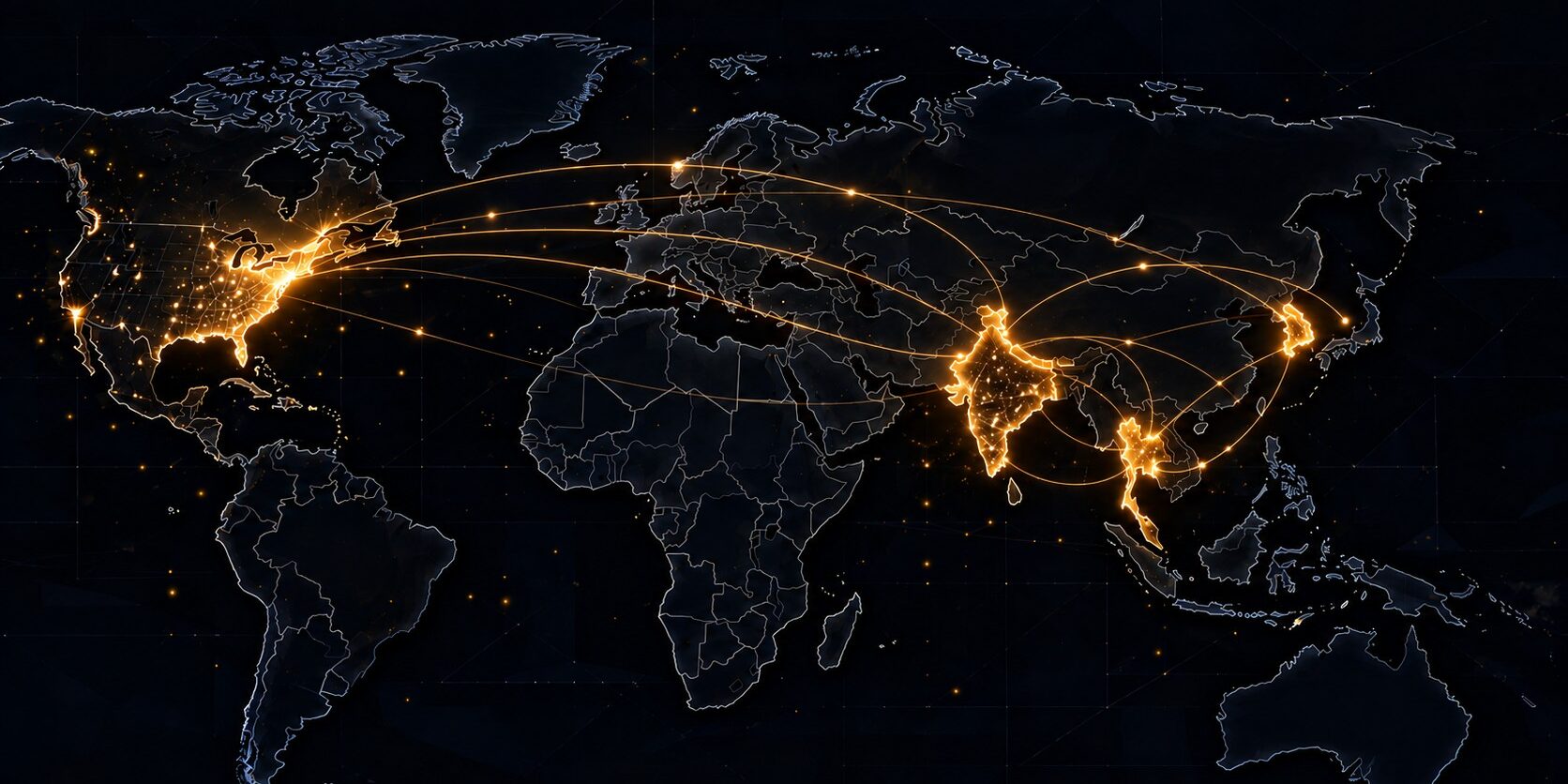
The AI infrastructure boom and elevated oil prices amid the conflict in the Middle East have split the world economy into a small set of winners and a larger set of losers, even as the global economic growth outlook remains surprisingly stable. This is according to the International Monetary Fund’s (IMF) latest World Economic Outlook report, released earlier this week.
The IMF projects global growth of 3.1% in 2026, down from 3.5% in 2025, before a recovery to 3.4% in 2027. These numbers are not significantly better or worse than expected before the US and Israel went to war with Iran in February this year. However, the report shows that this economic growth has become concentrated in countries with the most exposure to the AI economy.
The IMF says that just 32 economies now account for 95% of global growth, compared with 54 in April. Among emerging markets, the countries that play a major role in AI hardware supply chains – including South Korea, Malaysia, Mexico and Thailand – are expected to show robust growth for 2026 and beyond. India remains the world’s fastest-growing major economy, boosted by domestic demand, services activity, and AI investment.
Among major global north economies, the IMF forecasts US growth of 2.3% for both 2026 and 2027, with the economy boosted by private consumption, tax cuts and AI investment. The IMF lifted its forecast for the eurozone and the UK due to stronger investment in AI, participation in AI value chains, such as chemical production in Germany, and higher levels of defence spending.
At the other end of the scale, the IMF has downgraded growth forecasts for 47% of its measured economies due to war-induced supply shocks, including Middle Eastern countries on the front lines of the war. These economies are struggling to ship oil to global customers and have seen disruption to oil production due to damage to their infrastructure. Saudi Arabia, which is ensnared in conflict with the Houthis in Yemen, is now forecast to contract 3.3% this year, against 1.7% growth predicted in July.
Countries that rely on imports for a large portion of their oil and energy needs were also downgraded. The IMF cut its forecast for South Africa’s 2026 GDP growth from 1.1% to 1%. As an oil importer with minimal AI exposure, the country has faced inflationary headwinds from higher oil prices but has not benefited from tech investment tailwinds in the same way as many of its peers.
The IMF says that emergency government measures such as drawing down oil reserves, substituting other suppliers and energy sources, and cutting oil demand helped to cushion the world economy from further pain this year. The institution cautions, however, that the effectiveness of these measures is fading as the war in Iran drags on, and that its latest forecasts are based on assumptions that the Strait of Hormuz will reopen by March 2027.
At the same time, the reliance on AI to drive economic growth means that the outlook could deteriorate if expectations about AI-related profits and productivity gains are downgraded. Such a shift would trigger a sharp reduction in asset prices and tighter financial conditions that could cause a major drop in consumption. At this point, a resilient global economy may meet its limits, especially in the context of high government debt.
The IMF’s warning is timely, with equities set to end the week in the red. Investors are betting on further interest rate hikes from the Fed after high producer and consumer inflation readings in the US largely attributed to high oil prices. AI stocks slipped as investors considered how rising inflation and future interest rate hikes might impact companies that have taken on massive debt to build data centre infrastructure.
Global trends can reverse quickly, as the fading of the gold rally earlier this year showed. For now, AI is propping up global economic growth and has generated an outsized portion of equity returns for the past two years. In the longer term, questions arise about a sustained increase in AI infrastructure spending and, consequently, how growth will be reallocated between (or from) economies currently benefiting from this sector.
But in terms of oil supply, we anticipate a decrease in this commodity’s price during 2027. The regional conflict in the Middle East should eventually dissipate, and in the medium-term, oil producers will reduce their reliance on the Strait of Hormuz and develop alternative supply routes. As such, many economies negatively impacted by oil supply shocks will experience an increase in GDP for 2027, according to the World Economic Outlook.
“The global economy is not simply slowing or accelerating; rather, growth is being reallocated across countries according to their exposure to the war-induced supply shock and AI-related demand strength.”
– IMF World Economic Outlook
“Without shoring up supply capacity and replenishing policy buffers, the global economy could soon test the limits of resilience. Technology-related investment, while an important boon against the energy shock, is concentrating risks — making the global expansion heavily reliant on a small number of firms, sectors, and economies.”
– Silvana Tenreyro, IMF Economic Counsellor
Global News
- Investment in AI infrastructure is helping sustain global economic growth at around 3% despite disruptions to energy supplies, IMF MD Kristalina Georgieva said on Monday. Speaking at the IMF and World Bank annual meetings in Bangkok, she said the AI boom could boost growth in advanced Asian economies by up to one percentage point and emerging Asian economies by 0.8 percentage points, with semiconductor and hardware suppliers among the main beneficiaries.
- The US dollar rose to its highest level since May 2025 on Wednesday as stronger-than-expected inflation reinforced expectations of further Fed interest-rate increases. However, the currency reversed course on Thursday, with the Bloomberg Dollar Spot Index falling 0.3%, its biggest daily decline in more than a month. Concerns over AI-related debt drove investors towards US Treasury bonds, lowering yields and weakening the dollar despite persistent inflation pressures.
- The IMF urged governments on Wednesday to rein in deficits as global public debt approaches 100% of GDP, its highest level since World War Two. Rising bond yields, inflation and energy costs are increasing debt-servicing burdens, with interest payments consuming more than 15% of tax revenues in low-income countries. The IMF warned that delaying fiscal consolidation would further strain public finances, limit governments’ ability to respond to economic shocks and make future adjustments more difficult.
- US consumer prices rose 0.6% in September, their largest monthly increase in five months, pushing annual inflation to 3.7%, according to figures released on Wednesday. Petrol prices surged 9.1% amid continued disruption from the war in Iran, while core inflation increased 0.3%, indicating broader price pressures. Inflation-adjusted wages declined for a sixth consecutive month, further squeezing household purchasing power. The figures reinforced expectations of additional Fed interest rate increases.
- Inflationary pressures are intensifying across the US, with six of the 12 Fed districts reporting accelerating price increases, according to the Fed’s Beige Book released on Wednesday. Higher energy costs, tariffs and insurance premiums are driving up business expenses, while economic growth remains modest and employment largely unchanged. The findings highlight the Fed’s challenge of containing inflation without weakening economic activity ahead of its 27 to 28 October meeting.
- US Treasury bonds led a global government bond rally on Thursday as the technology selloff drove investors towards safer assets. The 30-year Treasury yield fell to a three-week low of 5.39%, despite stronger-than-expected US inflation. Yields stabilised on Friday, although concerns over AI-related debt continued to support bond demand. Major asset managers, including Pimco and Morgan Stanley Investment Management, see elevated yields as an investment opportunity, despite persistent inflation and government borrowing risks.
- China’s trade surplus reached $938 billion in the first nine months of 2026, putting it on course to surpass last year’s record $1.2 trillion, according to data released on Wednesday. Strong global demand for AI-related technology boosted September exports, including shipments to the US despite tariffs. The strength of overseas sales contrasts with weak domestic consumption, raising the risk of further trade tensions with China’s major trading partners.
- Wall Street’s record-breaking rally presents a tale of two markets, with strong headline earnings growth masking a widening gap between major technology companies and the rest of the market. S&P 500 earnings are forecast to rise 30.6% year-on-year in the third quarter, according to the London Stock Exchange Group. However, HSBC estimates that earnings growth across the rest of the market, excluding the Magnificent Seven and the technology and energy sectors, will slow to just 5%, from 14% in the previous quarter. With market gains increasingly concentrated among a handful of AI and technology giants, disappointing results from even one market leader could outweigh strong performances from numerous smaller companies.
- A global selloff in semiconductor and AI-related stocks intensified on Thursday as rising borrowing costs and concerns over AI investment returns unsettled investors. South Korea’s KOSPI plunged nearly 8%, and Japan’s Nikkei fell about 5%, while US investors shifted towards defensive sectors. The turmoil also disrupted AI data-centre financing, delaying or derailing major transactions despite record investment activity. The selloff highlights growing doubts about whether AI infrastructure spending can justify elevated valuations and debt levels.
- Broadcom CEO Hock Tan warned on Monday that access to capital, rather than semiconductor shortages, could become the biggest obstacle to AI industry growth. As hardware constraints ease, he questioned the sustainability of massive infrastructure investment, comparing speculative spending to casino gambling. However, he acknowledged the growing revenue potential of AI applications from companies such as OpenAI and Anthropic. His comments highlight the increasing importance of financing and sustainable returns as the AI industry expands.
- Meta CEO Mark Zuckerberg admitted on Tuesday that the company committed up to $200 billion to AI infrastructure without certainty that its technology would succeed. The disclosure followed Monday’s launch of Muse Wonder, which Meta claims can compete with leading AI models such as ChatGPT and Claude in coding, financial and legal tasks. Although shares initially rallied, investors remain concerned about the scale of spending and potential returns. With quarterly results due on 21 October, Meta faces pressure to demonstrate that its AI advances justify the investment.
- Anthropic, the developer of Claude AI, reported a 50% increase in third-quarter revenue to $16.8 billion on Wednesday, ahead of a potential IPO as early as November. The company achieved adjusted profitability, with prospective investors considering a valuation of up to $2 trillion. Its anticipated listing could become one of the largest in US history, contrasting with a slowdown in other IPO activity as rising interest rates and investor caution weigh on new offerings.
- Taiwan Semiconductor Manufacturing Company (TSMC), a key supplier to Nvidia, reported a 69% surge in third-quarter profit on Thursday, marking its sixth consecutive quarter of record earnings. Strong demand for advanced AI chips prompted the company to forecast fourth-quarter revenue of up to $54.3 billion. TSMC plans record capital expenditure of up to $64 billion this year and is exploring further US expansion, although management remains cautious about demand heading into 2027.
- Dutch chipmaking equipment manufacturer ASML raised its 2026 sales forecast to €44 billion to €45 billion on Wednesday, driven by strong demand for advanced semiconductor equipment. Despite plans to increase production capacity by 30%, the company expects demand to exceed supply through to 2028, with some customers already planning orders for 2029 and 2030. The outlook underscores sustained investment in AI chip manufacturing despite broader concerns about the sector’s spending levels.
- Apple became the second company after Nvidia to close above a $5 trillion market valuation on Wednesday, defying the broader technology selloff. The milestone reflects investor confidence in its profitability and relatively restrained AI spending compared with rivals. Under new CEO John Ternus, Apple faces pressure to strengthen its AI capabilities, with an upgraded Siri and its first foldable iPhone expected to support growth. Sustaining its valuation will depend on delivering these innovations while maintaining strong profitability.
- Morgan Stanley beat third-quarter profit expectations on Wednesday as volatile markets boosted equity trading and investment banking revenue. Profit rose to $4.91 billion, with equity trading revenue surging 41% as investors repositioned portfolios amid interest-rate uncertainty and the Iran war. Fixed-income trading revenue declined 7.3%, while wealth management attracted a record $232 billion in new assets. The results highlight the strength of Morgan Stanley’s diversified business model despite challenging market conditions.
- Netflix announced plans on Wednesday to cut approximately 1,000 jobs, representing 6% of its global workforce, amid slowing growth and weakening viewer engagement. Management maintained its full-year financial guidance despite the restructuring. Shares have fallen 25% this year as investors question the company’s growth prospects, with viewer engagement rising just 2% in the latest period. Netflix is expanding into live sports, podcasts and creator-led programming to attract viewers and boost advertising revenue.
- Luxury goods group LVMH reported a sharper-than-expected 5% decline in third-quarter sales at its key fashion and leather goods division on Monday, reflecting continued weakness in Chinese demand. Group revenue also missed forecasts, while the company’s shares have fallen more than 40% this year. The results highlight the challenges facing the global luxury sector as cautious Chinese consumers continue to weigh on sales.
- As at Thursday’s close the S&P 500 was 0.86% down for the week.
Local News
- Moody’s Ratings warned on Tuesday that South Africa’s 21 October medium-term budget would be a crucial test of fiscal discipline and prospects for a credit-rating upgrade. Meanwhile, Bank of America said on Thursday that higher profits from gold and other precious metals could boost tax revenue by R70 billion above budget in 2026/27. However, additional government spending could absorb approximately R53 billion of the windfall, limiting its fiscal benefit. The bank forecasts a budget deficit of 3.5% of GDP, below National Treasury’s 3.7% projection, reinforcing the importance of spending restraint ahead of next week’s budget.
- Dynasty attended an insightful webinar this week featuring Dr Frans Cronje, South African political and economic analyst and chairman of the Social Research Foundation. Dr Cronje shared his perspectives on South Africa’s upcoming local elections, evolving political landscape, the future of coalition governance and the implications for the country’s economic and investment outlook. The presentation, of just over one hour, provided valuable food for thought as South Africa navigates an increasingly complex political environment. Click here to watch the recording.
- ANC secretary-general Fikile Mbalula questioned the DA’s role in the Government of National Unity (GNU) on Thursday after the Constitutional Court reinstated 181 ANC candidates for the November municipal elections. The DA had opposed the ANC’s legal challenge over missed submission deadlines, prompting renewed tensions between the coalition partners. However, the ruling applies only to the ANC, leaving 2,093 candidates from 44 other parties excluded. The dispute raises questions about electoral fairness and the stability of the GNU.
- South African economic activity declined 0.4% in September, reversing August’s 1.2% increase, as rising fuel prices weighed on households and businesses. The PayInc Economic Index, released on Wednesday, remained 1.8% above year-earlier levels, indicating some resilience. However, record petrol prices and higher interest rates threaten to undermine the recovery, adding pressure to consumer spending and economic growth.
- The manufacturing sector faces mounting pressure from cheaper Chinese imports, which surged 29% in the first eight months of 2026 as US tariffs redirected Chinese exports towards alternative markets. Manufacturing’s share of the economy has roughly halved since 1994, while employment has fallen 25% since 2008. Moody’s Ratings identifies South Africa as particularly vulnerable to Chinese competition, with high energy costs and infrastructure constraints further threatening domestic production and jobs.
- South Africa plans to phase out the assembly of vehicles from imported kits and withdraw policy support for new semi-knock-down operations, Trade, Industry, and Competition Minister Parks Tau announced on Thursday. The government will tighten manufacturing requirements to encourage greater local production and job creation, while investigating the competitiveness of the light commercial vehicle sector, including bakkies and vans. The measures aim to strengthen domestic automotive manufacturing and reduce reliance on imported components.
- Mining production plunged 12.7% year-on-year in August, according to Statistics South Africa figures released on Tuesday, raising concerns about the sector’s impact on third-quarter GDP. Output also contracted 5.4% month-on-month, with platinum group metals, coal and iron ore recording significant declines. Rising operating costs, infrastructure constraints and years of underinvestment continue to limit producers’ ability to benefit from higher commodity prices, adding pressure to South Africa’s economic recovery.
- Municipalities facing declining electricity revenue as households switch to solar power cannot simply introduce new taxes to offset their losses, argues Municipal IQ MD Kevin Allan in a Thursday opinion piece. He warns that any additional charges must have a clear legal basis and comply with existing legislation, and questions why municipalities are pursuing new revenue streams rather than improving debt collection. The debate highlights growing pressure on municipal finances as electricity consumption patterns change.
- Johannesburg Water is seeking private-sector partners to address worsening water shortages, having issued a request for information on 6 October. The initiative could attract investment in water production, metering and infrastructure management as ageing networks struggle to meet demand. Meanwhile, City Power is seeking AI specialists to overhaul its electricity billing system and address annual losses of approximately R3.45 billion in annual non-technical losses. Both initiatives highlight Johannesburg’s growing reliance on private expertise and technology to improve essential services and strengthen municipal finances.
- Four of South Africa’s five major listed grocery retailers have announced CEO changes in recent months amid intensifying competition and pressure to improve performance. Pick n Pay, Boxer, Woolworths and Spar are undergoing leadership transitions, while Shoprite’s Pieter Engelbrecht remains in place. The reshuffle reflects growing pressure on retailers to improve profitability, defend market share and challenge Shoprite’s dominance.
- Moody’s Ratings expects Discovery Bank’s assets to grow by approximately 21% annually over the next two to three years, with the lender forecast to achieve overall profitability in its 2027 financial year. In its assessment on Wednesday, Moody’s highlighted the bank’s digital-first model and behaviour-linked rewards as competitive advantages. Discovery Bank has nearly 1.6 million clients and reported a normalised operating profit of R370 million for the year to June. However, rapid expansion, limited diversification and relatively untested products remain key risks.
- A proposed R6.7 billion Formula 1 circuit near Cape Town remains on track despite Rwanda securing a 10-year agreement to host an African Grand Prix. The consortium, led by former Sibanye-Stillwater CEO Neal Froneman, reaffirmed its ambition on Wednesday to host a race by 2031. The Swartland development could boost tourism and infrastructure investment, although Rwanda’s agreement raises uncertainty over Cape Town’s prospects of joining the Formula 1 calendar.
- As at the time of writing, the rand was 0.45% stronger against the dollar, and the ALSI was 1.8% up for the week.
Sources: Dynasty, Bloomberg, Reuters, Business Day, Moneyweb, Wall Street Journal, etc.