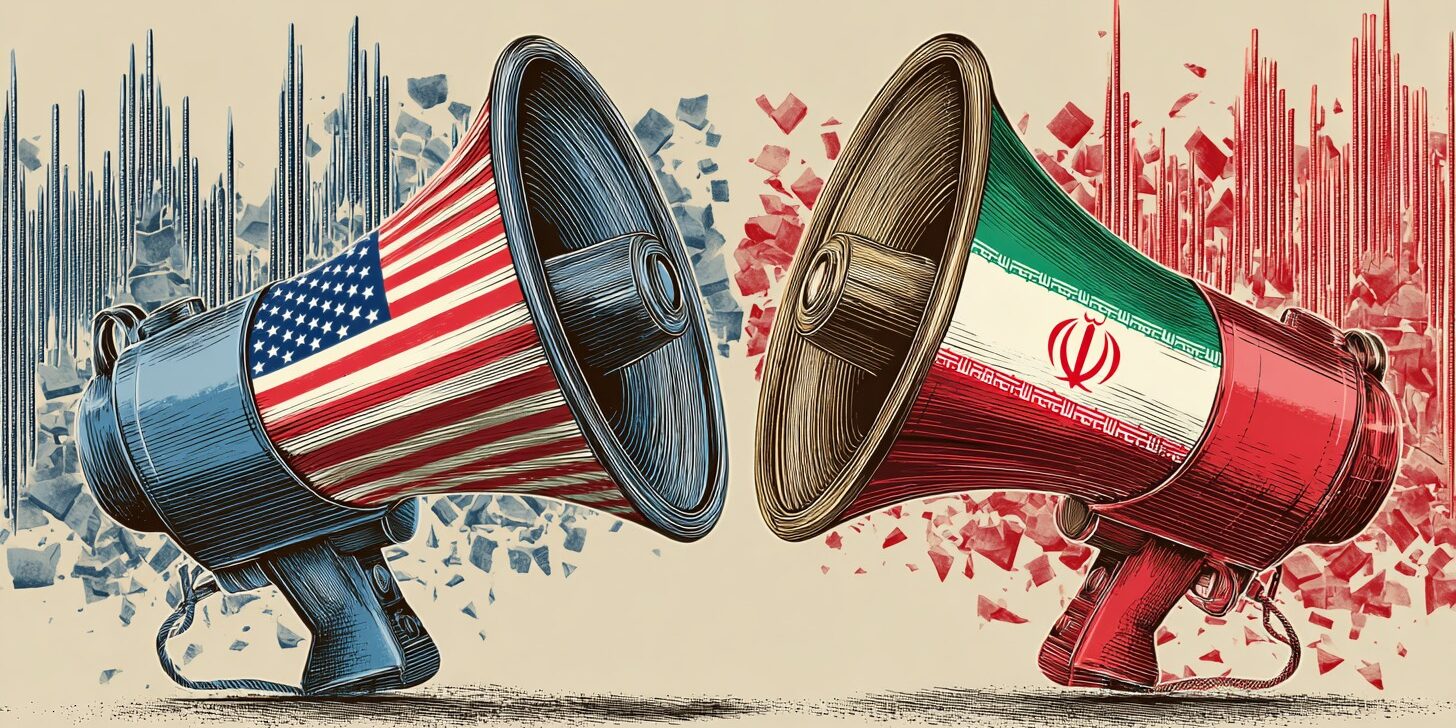
Four weeks into the US-Israeli campaign against Iran, the media landscape is proving to be as consequential a battlefront as the Persian Gulf. As Bloomberg observed this week, each side has kept up attacks even amidst renewed efforts to ‘jawbone’* the other into a resolution. US President Donald Trump can claim he is correct in that the war in Iran hasn’t triggered a super-spike in the oil price many had feared. Through his rhetoric about having been ‘begged’ by Iran to end the conflict, this ‘jawboning’ can be construed as an effort to manage oil prices as well as convince his Iranian adversaries that he can continue the campaign indefinitely.
So far, the strategy appears to be working. Each time Trump signals that negotiations are underway or that the war is near its end, oil prices soften, and equity markets stabilise. Although volatile, Brent crude has not yet traded at the $130 level that it breached after Russia invaded Ukraine in 2022.
Tehran and Washington are now in a war of words as much as one of military force. Each time Trump hints at imminent peace talks, oil prices fall. Iranian leadership, in turn, denounces these claims because high oil prices and global supply chain disruptions are its leverage for negotiating its most favourable outcomes to the war.
The most recent development after a market rout yesterday: Trump announcing that his administration will hold off on strikes to Iranian energy sites for another 10 days. This follows a five-day pause Trump declared earlier this week, a move that had calmed markets after his threat to bomb Tehran’s energy grid last week Friday.
Trump’s jawboning works because of the phenomenon Wall Street has named TACO – Trump Always Chickens Out. Following the “Liberation Day” tariff announcements in April 2025, Trump ultimately imposed less severe levies than he had initially threatened. Markets have become conditioned to expect partial capitulation to follow Presidential bluster.
Indeed, Deutsche Bank has captured this Trumpian behaviour in a “Pressure Index” that tracks Trump approval ratings, inflation expectations, S&P movements and Treasury yields to anticipate the next policy pivot. The index recently hit a record high, suggesting that the next TACO moment might be near.
The danger is that Trump may reach the limits of language sooner than he imagines. Trump can jawbone oil and equity traders. He cannot necessarily talk Iran into a ceasefire. If Iran decides to escalate or when physical shortages spread beyond Asia into European and American markets, reality will overtake rhetoric. However, Trump’s retreat might also be buying time to amass troop numbers while Iran’s government seems to have become more hardline since the war began.
Meanwhile, gas prices at the pump are already up 25% in the US. The longer the war drags on, the longer it will take to rebuild inventories and restore normal oil and gas flows. In the end, the fundamentals will trump the narrative. The war’s trajectory will shape interest rates, earnings, and consumer confidence, which, in turn, will determine how markets perform.
Until then, we can expect the markets to be moved by the duelling narratives from Washington and Tehran as much as by battlefield realities.
*Jawboning (in the context of the war) is the use of political authority to persuade opposing entities to act in certain ways, which is often underpinned by implicit threats of escalating military action and economic disruption.
“Fake news is used to manipulate the financial and oil markets and escape the quagmire in which the US and Israel are trapped. We’re aware of what is happening in the paper oil market.”
– Mohammad-Bagher Ghalibaf, a prominent Iranian leader
Global News
- Efforts to end the Iran–Israel conflict intensified this week as the US put forward a ceasefire proposal aimed at curbing Iran’s nuclear and missile programmes in exchange for sanctions relief, but Iran rejected the terms and presented its own demands, including security guarantees, reparations and recognition of its control over the Strait of Hormuz. Despite ongoing backchannel negotiations involving intermediaries such as Pakistan and Turkey, military strikes between Iran and Israel have continued, underscoring the gap between the parties.
- Doubts over a near-term ceasefire drove markets lower this week, with oil prices rising and equities and bonds falling, extending volatility since the war began. Markets stabilised slightly after Thursday’s close as Trump extended his deadline for Iran to reopen the Strait of Hormuz to 6 April, easing immediate fears of further escalation. Analysts are warning that prolonged disruption could remove 13–14 million barrels per day from global supply and keep prices elevated, or even drive them higher, if the conflict persists.
- Although most financial assets have fallen since the onset of the war, the dollar is on track to achieve its biggest monthly gain since July last year, boosted by safe haven flows and the reduced likelihood of interest rate cuts.
- Trump’s approval rating fell to its lowest level since his return to office, according to a Reuters/Ipsos poll released this week, as rising fuel prices linked to the Iran war weigh on public sentiment. The survey showed declining support for his handling of the cost of living and broader economic policy, while backing for US strikes on Iran has also weakened. The findings reflect growing concern about the impact of the conflict and rising energy costs, highlighting how war-related pressures are eroding confidence in the administration and could weigh on political stability and investor sentiment.
- Deutsche Bank said on Tuesday that the Iran war could accelerate a shift away from the dollar in global oil trade, raising the prospect of a growing role for the Chinese yuan. The bank cited reports that Iran is allowing oil shipments through the Strait of Hormuz provided payments are made in yuan, with China its largest customer. The development points to early signs of a potential “petroyuan” system and suggests a gradual weakening of the dollar’s dominance in global trade and reserve systems as geopolitical tensions reshape payment dynamics.
- Russia’s oil revenues have surged to their highest since just after the 2022 Ukraine invasion, as the Middle East conflict reshapes flows and pricing power. Export earnings have doubled in three weeks to about $270 million a day as of Tuesday, driven by stronger prices, higher shipments and improved margins as discounts narrow. A US waiver has boosted sales to India, while tighter global supply has pushed Russian grades to premium levels, giving Moscow a short-term financial windfall despite ongoing sanctions pressure.
- The Iran war is dealing a fresh blow to Europe’s industrial sector, according to a Reuters report published on Monday, as surging energy costs add to existing pressures from weak demand and global competition. Energy-intensive industries such as chemicals, metals and manufacturing are facing rising production costs and declining competitiveness, particularly in Germany’s industrial heartland, where companies are already grappling with structural challenges. Business leaders warned that repeated shocks are accelerating the risk of deindustrialisation, as firms scale back output, delay investment or shift production outside Europe.
- Software stocks fell on Tuesday after a report that Amazon is developing new AI tools, fuelling concerns about increased competition in the sector. Amazon Web Services is developing an AI agent to automate functions for sales, business development, and other groups targeted in the tech giant’s sweeping job cuts. The agent handles work typically done by thousands of specialists in areas such as cybersecurity and server networking. An exchange-traded fund tracking software stocks fell, with UiPath and HubSpot among the biggest decliners, down about 9%.
- Memory chip stocks fell sharply on Thursday after Alphabet’s Google highlighted a new AI algorithm, TurboQuant, that could reduce memory requirements by up to six times. Samsung Electronics and SK Hynix dropped at least 6%, while US peers including Micron, Western Digital and Sandisk fell more than 7%. Although the new technology could alleviate the supply crunch, potentially pushing down prices, some analysts believe it may be beneficial for memory makers in the longer term due to higher product adoption demand.
- Apple is preparing to introduce advertising in its Maps app, with an announcement possible as early as March, according to sources on Monday. This comes as it expands its services revenue strategy. The feature will allow businesses to bid for placement in search results, similar to existing models used by rivals. The move comes as Apple’s services unit, which generates over $100 billion annually, faces regulatory pressure and potential disruption from AI-driven search, making new ad revenue streams increasingly important.
- Estée Lauder and Spain’s Puig said on Monday they are in talks over a possible merger that could create a $40 billion luxury beauty group, as consolidation accelerates in the sector. The companies confirmed discussions but said no agreement has been reached and that there is no certainty a deal will proceed. The tie-up would strengthen their position in fragrances and help compete with larger rivals like L’Oréal, even as both face slowing demand and operational pressures.
- As at Thursday’s close the S&P 500 was 0.45% down for the week.
Local News
- The JSE is heading for its worst month since the 2008 financial crisis, with the All-Share Index down nearly 14% in March as of Monday due to the war in Iran. Mining and banking stocks have led the sell-off, with precious metals shares dropping more than 29% during the month, wiping out billions in value. The South African Chamber of Commerce and Industry on Monday called for an immediate halt to the war, saying the conflict will have serious adverse effects on the global economy while also pushing up inflation and interest rates.
- The South African Reserve Bank held interest rates steady at 6.75% on Thursday, with Governor Lesetja Kganyago stating that policymakers are prioritising caution amid the Iran war, which is driving up global energy prices and inflation risks. The Monetary Policy Committee’s decision reflects concern that earlier improvements in inflation will reverse, with fuel costs and a weaker rand expected to push prices higher, prompting the bank to warn it may even consider rate hikes if the conflict persists. The rand declined 0.3% to R17 within 30 minutes of the announcement.
- Nedbank said on Wednesday that rising oil prices and a weaker rand could reignite inflation, putting pressure on already fragile South African consumers. Economist Crystal Huntley said the economy had entered the year with improving conditions, including inflation near 3% and early benefits from interest rate cuts, but the external shock is now reversing that progress. Nedbank’s modelling suggests inflation could rise to around 5% in the coming months, or approach 6% in a worst-case scenario, depending on the duration of the conflict.
- France has withdrawn President Cyril Ramaphosa’s invitation to the G7 summit in June after sustained pressure from the US, including a threat to boycott the event if South Africa attended, the Presidency said on Thursday. Spokesperson Vincent Magwenya said the decision was conveyed through diplomatic channels and accepted by South Africa, with no expected impact on bilateral relations. However, France denied that South Africa’s exclusion was due to pressure from Washington, instead inviting Kenya as the sole African guest following discussions among G7 members.
- The Department of Mineral and Petroleum Resources and the Fuels Industry Association said on Wednesday that reopening closed oil refineries will not provide a short-term solution to rising fuel prices, as the country remains heavily reliant on imported crude. They added that fuel costs will continue to be driven by global oil prices, exchange rates and geopolitical disruptions. South Africa has lost nearly half of its refining capacity, around 300,000 barrels per day, increasing its dependence on imports, while plans to revive facilities would take years and require significant investment.
- South Africa remains a hotspot for illicit and counterfeit trade, with the underground economy estimated at about 20% of GDP, the Drinks Federation South Africa and the Transnational Alliance to Combat Illicit Trade said on Wednesday. Tobacco, alcohol and clothing are among the most affected sectors, with weak enforcement and porous borders allowing goods to enter and circulate without duties. The trade is expanding alongside the informal economy and is increasingly linked to organised crime, despite recent policy and enforcement improvements.
- Sasol’s market value has surged in recent weeks as the Iran war drives a sharp rise in global oil prices and the weaker rand pushes up revenue, with investors piling into the stock on expectations of stronger earnings. As of Monday, the group was worth more than R136 billion, having added R56.3 billion since the day before the war broke out on 27 February. The company’s stock has doubled since the start of the year.
- Glencore’s talks with Eskom over a discounted electricity deal to keep its ferrochrome smelters running are on the brink of collapse, with the miner warning current conditions are “commercially unworkable,” it said on Wednesday. The company has given the utility less than a week to agree to revised terms or risk the deal falling through. Failure to reach an agreement by the end of this month could see Glencore proceed with plans to cut about 2,500 jobs.
- Investec has restructured its South African operations to target the corporate midmarket, bundling private banking, lending and advisory services under a single business and commercial banking unit, it said on Tuesday. The group aims to add about 1,500 midmarket clients a year and grow segment revenue to R3.8 billion by 2030. The shift targets a R600-billion-plus loan pool, with the lender positioning itself to compete more directly with incumbents in an underserved segment.
- Standard Bank said on Thursday it expects to meet its medium-term growth targets, with headline earnings per share projected to grow 8%–12% a year between 2026 and 2028. The group is targeting revenue growth of 7%–10%, supported by continued investment in technology, payments and AI, after delivering on its previous targets. Standard Bank nearly doubled its profit in the period between 2021 and 2025 to a record R49.2 billion – ahead of its baseline 2021 targets.
- As at the time of writing, the rand was 1.1% weaker against the dollar, and the ALSI was 0.6% up for the week.
Sources: Dynasty, Bloomberg, TechCentral, Reuters, Business Day, ITWeb, CNN, Business Report, etc.