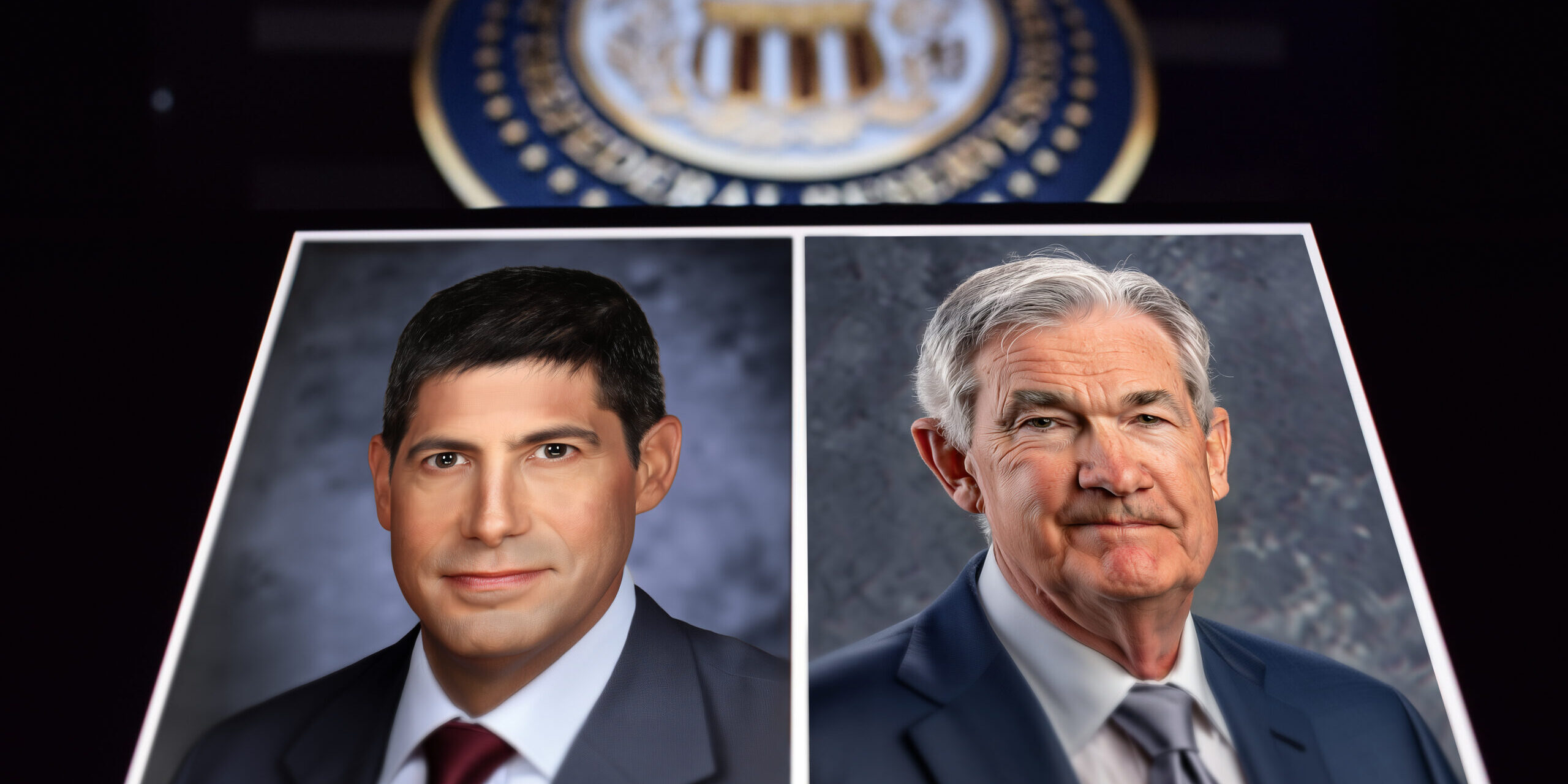
US President Donald Trump last week named Kevin Warsh as his preferred chair for the US Federal Reserve at a fraught moment for monetary policy. Warsh’s nomination comes at a time when many market participants are concerned about the Fed’s independence and the pressure Trump has placed on the central bank to slash interest rates.
Against that backdrop, commentators and markets greeted Warsh’s nomination with cautious relief. Warsh is an experienced and credible candidate who served as a Fed Governor between 2006 and 2011. He helped to shepherd the US financial system through the Global Financial Crisis, when he was the key liaison between banks and the Fed.
Warsh had a reputation as an inflation hawk with deep scepticism of loose monetary policy and the Fed’s vast bond-buying programmes. However, the Warsh who returns to the Fed in 2026 appears changed from the one who ended his term 15 years ago. In particular, Warsh has recently shared Trump’s enthusiasm for lower interest rates.
Echoing the wider promises of Trump and the Make America Great Again (MAGA) movement, Warsh appears determined to bring about regime change at the Fed. His conviction that conditions are now favourable for lower interest rates is just the starting point for his proposed reset.
Warsh favours a forward-looking approach to setting monetary policy over the Fed’s traditional reliance on lagging economic indicators such as inflation prints and employment reports and he postulates that surging productivity, particularly gains fuelled by artificial intelligence (AI), could suppress inflation. He argues that if technology and deregulation allow firms to produce more with fewer inputs, the economy could grow faster without catalysing price increases. This, theoretically, paves the way for easier monetary policy. (Of course, in this situation, a weaker job market would in itself provide a justification for interest rate cuts.)
These ideas worry Fed critics who believe the central bank reacted too slowly to crises such as COVID-fuelled inflation. Without reliable, validated statistics, monetary policy risks drifting into speculation. The productivity gains from AI and the tailwinds from deregulation remain uncertain in scale and timing, for example.
Warsh has remained a consistent critic of quantitative easing (QE) over the decades. He blames QE for government wastefulness, misallocated capital and a fragile banking system. Warsh’s proposal is to potentially sell off US Treasuries to get them off the Fed’s balance sheet as soon as possible rather than to allow them to mature.
The proposed Fed chair argues that shrinking the $6.6 trillion balance sheet will open the way for cheaper borrowing on Main Street. But with large volumes of US government debt needing to be rolled over, Treasury yields could spike if the Fed offloads bonds. The result could be a steeper yield curve, higher long rates and unsettled bond markets.
Warsh’s appointment may prove to be messy and delayed. Resistance from Democrat senators and at least one Republican highlights concerns about the political pressures the Fed faces. While the Fed is far from perfect, more radical change at a time when policy uncertainty under Trump is already elevated may not be welcomed.
Still, Warsh returns to the Fed with a track record of free thinking and a wide intellectual network. He may yet prove to irritate Trump with his independence as much as the incumbent, Chairman Jerome Powell, did. Warsh faces a complex balancing act when he takes over from Powell.
He will need to keep the Fed board onside to implement his policy changes and bring down rates while maintaining the confidence of a mercurial president. At the same time, markets will be watching his actions closely in an era when investors are increasingly skittish about American assets.
Much will depend on how Warsh balances central bank independence with his bold ideas and on how macroeconomic conditions evolve. But if his agenda delivers lower rates alongside balance-sheet reduction, we could see continued US dollar weakness, resilient precious metal prices and potential for emerging markets. Lower rates will also provide support for equities in general, including those in the US.
Our view is that Warsh will need to move quickly to win the market’s confidence at a time when many investors and central banks worldwide are diversifying from US dollar assets. It is for this reason that we are in the process of broadening our exposure beyond just the US and developed markets, and look to include Emerging Market exposure into portfolios, where possible.
“We need regime change in the conduct of policy. The credibility deficit lies with the incumbents that are at the Fed, in my view.”
– Kevin Warsh
“Productivity is notoriously difficult to predict.”
– Former Federal Reserve Chairman, Alan Greenspan
Global News
- Trump last Friday nominated Warsh to lead the Fed when Powell’s term ends in May, picking a long-time Fed insider aligned with Trump’s preference for lower interest rates and greater executive influence over monetary policy. Warsh, a lawyer and former investment banker, served on the Federal Reserve Board of Governors from 2006 to 2011, including through the global financial crisis, and later became a fellow at the Hoover Institution, where he critiqued the central bank’s approach and advocated for changes to its operations.
- Trump’s bid to install Warsh has been slowed by ongoing political tensions with Powell, including a rare criminal investigation that has drawn bipartisan criticism and could delay Warsh’s confirmation, meaning Trump may need to ease the feud to allow his nominee to take the helm and push for lower interest rates.
- The partial US federal government shutdown ended late Tuesday after Trump signed a funding deal he negotiated with Senate Democrats into law, overcoming opposition from both Republicans and Democrats and reopening most federal agencies. Trump pitched the funding package as a win for the American people, but it continues to fund controversial immigration enforcement actions and only provides temporary funding for the Department of Homeland Security until 13 February, meaning another negotiation will soon be needed.
- US companies announced the largest number of job cuts for any January since the 2009 Great Recession, with 108,435 layoffs in January 2026, representing a 118% increase from a year earlier, according to a report released yesterday by Challenger, Gray & Christmas. Hiring intentions also fell sharply to 5,306, down 13% from a year ago and the weakest January total on record. The figures point to softer labour demand and growing caution among employers as companies restructure and adjust staffing in response to a more uncertain economic outlook.
- US private-sector employment increased by 22,000 in January, according to the ADP National Employment Report released on Wednesday. The result significantly missed economist forecasts of a 45,000-job gain and followed a downwardly revised 37,000 increase in December. Hiring was heavily concentrated in education and health services, while most other sectors shed jobs.
- US manufacturing activity unexpectedly expanded in January at the fastest pace since 2022, fuelled by a surge in new orders and production. The Institute for Supply Management manufacturing index rose to 52.6 from 47.9, beating expectations, according to data released on Monday. New orders jumped nearly 10 points, while production reached its highest level since early 2022.
- The US hosted a critical minerals summit on Wednesday with 55 countries, where it proposed price floors and increased private-equity investment to reduce reliance on Chinese supplies of key minerals used in technology and manufacturing. The EU, Japan, and Mexico agreed to explore such price floors and work toward a binding multilateral trade agreement to stabilise supply chains and attract investment, with US officials warning that volatile prices have deterred capital and left markets exposed to Chinese dominance. The strategy also includes plans for a nearly $12 billion US strategic stockpile to secure reliable access for domestic manufacturers.
- Trump and Indian Prime Minister Narendra Modi on Monday agreed that the US will significantly cut tariffs on a wide range of Indian goods, lowering average duties to 18% from as high as about 50% on some products, in exchange for India’s pledge to stop buying Russian crude oil.
- Precious metals swung sharply this week after last Friday’s historic sell-off. Spot silver has traded in a range of $120 last Thursday to $64.05 on Friday, after last Friday’s 30% plunge marked the biggest one-day sell-off since 1980. Gold fell to $4,400 briefly on Monday, after last week’s high of $5,600, to then fluctuate between $5,080 on Wednesday and $4,700 on Friday.
- UBS said on Monday that the sharp drop in gold and silver prices has limited economic significance, arguing the sell-off is more likely due to an exhausted “fear of missing out” trade than a shift in fundamentals. Because the rally was too short-lived to create meaningful wealth effects, a correction toward prices aligned with economic fundamentals could even be positive by avoiding resource misallocation.
- Copper prices fell below $13,000 a ton on Thursday after reaching a record of $14,500 last week, extending losses as investors focused on rising stockpiles in London Metal Exchange warehouses and signs of weakening demand from Chinese buyers.
- Bitcoin tumbled to below $60,000 in early Asia trade this morning, extending a selloff that has erased all gains since Trump’s election sparked a crypto rush. The 48% rout since October has spread to other tokens, ETFs, and companies such as Strategy and hit exchanges including Coinbase and Gemini.
- Shares of legal software and data companies plunged after Anthropic released a new AI automation tool on Tuesday, triggering a broad sell-off in software and tech stocks as investors dumped companies seen as vulnerable to disruption, with legal research and analytics firms among the hardest hit. The rout quickly spread across the tech sector, contributing to a wider tech sell-off.
- Nvidia CEO Jensen Huang on Wednesday rejected the notion that AI will displace traditional software, arguing that such claims are “illogical” and reflect a poor understanding of how the technology functions. He said AI is layered on top of existing software rather than replacing it, and that developers will continue to need core software to build, operate and manage AI systems.
- UBS, meanwhile, said the technology sector may be facing a valuation dilemma: if AI proves truly disruptive, will it end up disrupting technology companies themselves, and if it is not, are tech stocks still overvalued?
- Amazon.com shares fell about 10% in extended trading in New York yesterday after the company said it plans to spend about $200 billion in 2026 on data centres, chips and other equipment. CEO Andy Jassy said most of the investment would go to Amazon Web Services, largely for AI workloads. AWS revenue rose 24% to $35.6 billion – the biggest quarterly growth in more than three years. Amazon forecast current-quarter operating income of $16.5 billion to $21.5 billion, below analysts’ average estimate of $22.2 billion.
- Alphabet said on Wednesday that it expects to spend far more this year than investors had anticipated, forecasting capital expenditures of $175 billion to $185 billion to expand data centres and other infrastructure needed for its artificial-intelligence push.
- Elon Musk is combining SpaceX and xAI in a deal that values the combined company at $1.25 trillion, with SpaceX at $1 trillion and xAI at $250 billion. SpaceX said on Monday the acquisition aims to create a vertically integrated innovation engine covering AI, rockets, space-based internet, mobile communications and real-time information. The company is still planning an initial public offering later this year.
- Walmart became the first retailer to reach a $1 trillion market valuation on Tuesday, following a year-long rally that lifted its shares by nearly 26%. The stock has risen 468% over the past decade, outpacing the S&P 500’s 264% gain, as Walmart appeals to both higher-income and core lower-income shoppers. Investments in AI-driven supply-chain automation, online expansion, one-hour delivery, Walmart+, and a $4 billion advertising business have helped the retailer beat US same-store sales estimates for 15 consecutive quarters.
- Novo Nordisk shares fell sharply this week after the company forecast a sales decline of up to 13% in 2026, citing intensifying US price competition, cutting its market value to about $215 billion from over $600 billion in 2024. Shares dropped 20% on Tuesday in Copenhagen and 17% on Thursday after telehealth firm Hims & Hers launched a cheaper copycat of Novo’s Wegovy weight-loss pill, which the Danish drugmaker says is illegal. In contrast, Eli Lilly’s stock rose as much as 11% in New York after lifting its sales growth outlook to as much as 27% on Wednesday, supported by strong demand for Mounjaro and Zepbound and longer patent protection.
- As at Thursday’s close the S&P 500 was down 2% for the week.
Local News
- Trade, Industry, and Competition Minister Parks Tau welcomed the one‑year extension of the African Growth and Opportunity Act (AGOA) but warned its short duration creates uncertainty for businesses. Tau said the extension may provide relief for South African exports and that talks continue with the US to reduce a 30% tariff on local goods. He called for a longer‑term programme to provide certainty around investment and purchasing decisions.
- DA leader John Steenhuisen announced on Tuesday that he plans to step down at the end of his current term and will not seek re-election at the party’s April elective conference, ending months of speculation and internal pressure over his leadership. His decision paves the way for potential successors, including Cape Town Mayor Geordin Hill-Lewis, to contest the top post, and comes amid broader tensions within the Democratic Alliance over policy decisions. As the party plays a key role in the country’s 10-party Government of National Unity, the leadership change raises fresh questions about the future direction of South African politics.
- The search for a new South African Revenue Service (SARS) Commissioner has hit headwinds, with the panel requesting additional candidates, Finance Minister Enoch Godongwana said yesterday. Outgoing commissioner Edward Kieswetter said his SARS tenure should serve as a model for rescuing distressed state entities.
- The private sector showed signs of stabilising at the start of 2026, with the S&P Global South Africa Purchasing Managers’ Index returning to the neutral 50.0 level in January, according to data released on Wednesday, ending the deterioration seen in late 2025. The reading reflected steadier demand, easing price pressures, and a levelling off in output after December’s contraction, with new business volumes broadly balanced. While the improvement points to a firmer start to the year, momentum remains fragile and a sustained recovery is not yet assured.
- Rio Tinto said yesterday it will not make an offer for Glencore after talks between the two miners collapsed over differences in valuation, ending a potential merger that would have created the world’s largest mining company. The companies confirmed discussions in early January 2026. Rio has a market capitalisation of about $157 billion, compared with Glencore’s $76 billion. Glencore shares fell as much as 11% after the announcement, while the company said it remains focused on its standalone strategy. A potential merger has been floated several times over more than a decade.
- Impala Platinum said on Tuesday that headline earnings per share for the six months to December are expected to rise between 392% and 411%, driven by higher achieved dollar platinum group metal basket prices and operational performance. The share price rose 3.82% in early trade.
- Sasol expects headline earnings per share for the six months to end-December to fall 29% to 40% due to lower rand oil prices, weaker chemical prices, and R7.8 billion in impairments, the company said yesterday. Earnings per share are forecast at 10c to 80c cents, down from R7.22, and headline earnings per share at R8.50 to R10, versus R14.13 previously. Shares fell 5.2% following the news.
- Isuzu Motors South Africa (IMSAf) recorded strong growth in 2025, with domestic sales rising 12.2% to just over 26,000 vehicles and exports to other African markets up 4.5%. The company maintained its position as South Africa’s leading truck brand in the combined medium- and heavy-commercial vehicle segments for the 13th consecutive year, driven by heavy commercial sales. On Wednesday, IMSAf highlighted ongoing investment in its Eastern Cape operations, including local manufacturing, supplier and skills development, plant automation, dealer expansion in Lesotho and Angola, and new facilities such as ISUZU Cape Gate.
- As at the time of writing, the rand was 0.1% weaker against the dollar, and the ALSI was 1% down for the week.
Sources: Dynasty, Bloomberg, CNN, BusinessDay, Reuters, TechCentral, Business Report, etc.