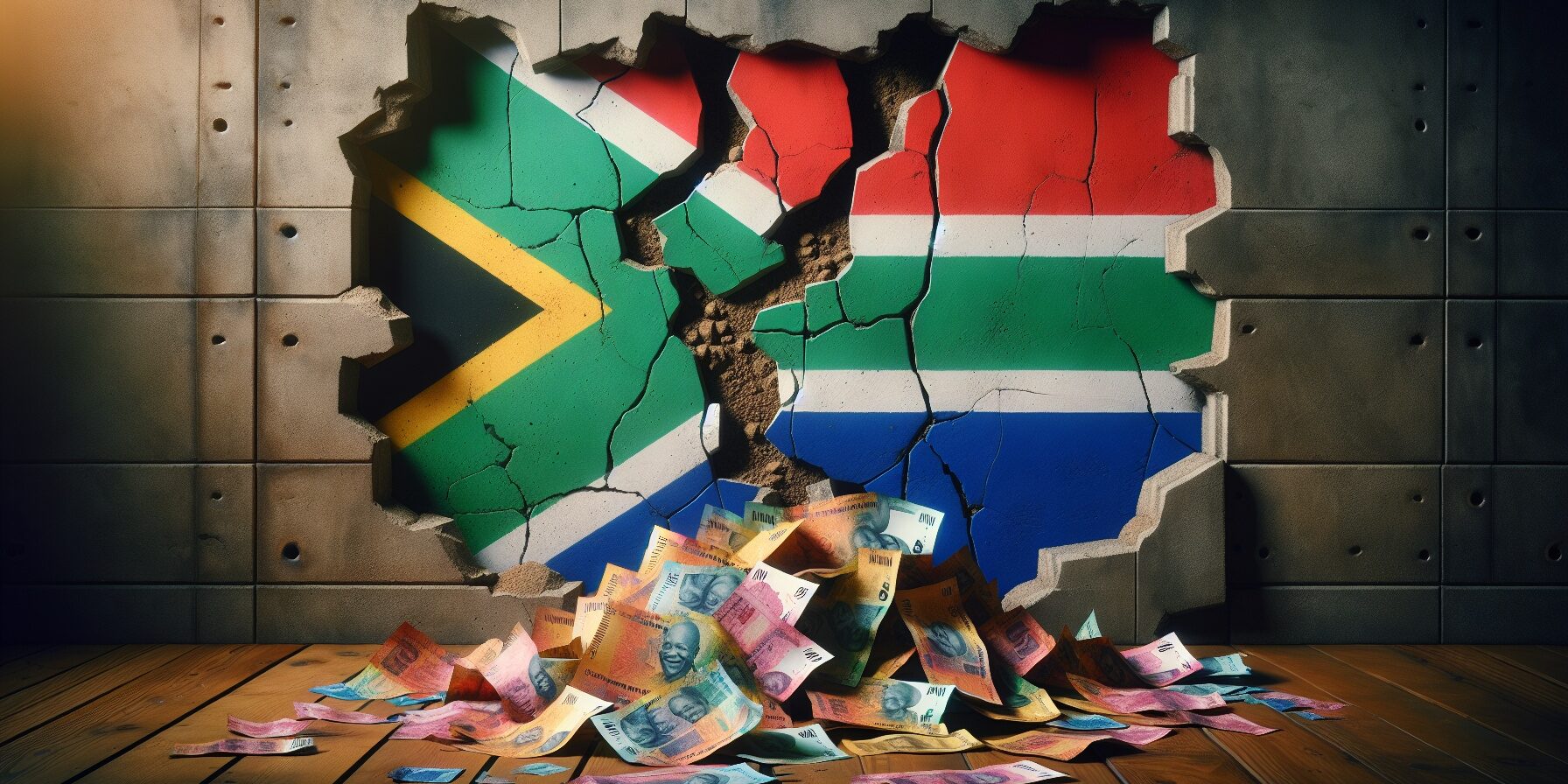
The South African rand has a well-deserved reputation for volatility, but April has been a month of particularly choppy trading. Since the start of the month, we have seen the rand plummet from around R18.30/$ to an intra-day low of R19.92/$ on 8 April – before recovering to around R18.88/$ at the time of writing.
Although the rand is traditionally highly exposed to global macroeconomic conditions and emerging market sentiment, it is our contention that the latest drop and rebound is primarily about the local politics of the Government of National Unity (GNU). Indeed, the rand’s recent fall and recovery has not been closely correlated to the movement of the dollar.
The US dollar’s value has slumped against the developed world currencies in the DXY index by 8.4% since the beginning of the year. While the euro and pound have strengthened against the dollar, last week the rand weakened to respective record intra-day lows of R22.14 and R25.46 against these currencies. It has also underperformed emerging market peers.
Our currency decoder, which we use to calculate the fair value of the rand and incorporates both local and international factors in its model, indicates that the bulk of the rand’s movements this month are attributable to South African-specific factors and there is a residual impact which is likely to weigh on the rand for the foreseeable future.
This suggests that the brinksmanship in the GNU and fears that the Democratic Alliance (DA) would leave the grand coalition over a dispute about the budget caused the majority of the weakening of the rand. Calls from African National Congress (ANC) hardliners to eject the DA from the GNU spooked investors. Conversely, the sharp rebound occurred as reports started to surface that the ANC and DA had patched their relationship.
For now, the country is holding its breath to see whether the GNU parties and the National Treasury manage to scrap the proposed 0.5 percentage point VAT increase before it is due to go into effect on 1 May. But the wrangling over the budget wasn’t the first dispute between the ANC and the DA and it is unlikely to be the last.
The GNU remains a patchwork of ideologically diverse parties, with the DA’s more business-friendly orientation at odds with the ANC’s belief in an interventionist state. Differences around economic reform, foreign affairs, National Health Insurance, and other matters of policy mean that friction in the GNU will be a fact of life for as long as it lasts.
Recent polling from the Institute of Race Relations suggests that support for the ANC continues to slip among people who are likely to vote, to the point where the ANC ranks behind the DA for the first time. Furthermore, the ANC’s popularity would be even lower without Cyril Ramaphosa as its leader. This reality means that the ANC realises that making the GNU work is key to the party’s future. On balance, the DA, similarly, is aware that it is better served inside the GNU than outside.
Hopefully, all parties in the coalition may have learned some hard lessons in the two months that have passed since the ANC postponed the initial budget speech in February. We would hope, for example, that the ANC will negotiate future budgets with its partners in the government rather than trying to table them unilaterally.
Globally, a softening of US protectionist trade stances and a more favourable, albeit temporary, US tariff regime to South Africa have also served as external tailwinds in the currency’s recent rally.
Given the weaker dollar, our currency decoder suggests that, despite the recent recovery, the rand remains undervalued versus the dollar, and we are cautious about externalising funds for clients at these levels. Continued dollar weakness and higher gold prices could favour the rand, but conversely, a reversal of the current dollar weakness could see the fair value of the rand rise and reduce the discount without any further rand strength.
On a longer-term horizon, the rand remains vulnerable to internal politics and global shocks. Political risks remain high, and the lack of consensus between GNU parties means that economic reforms are unfolding at too slow a pace.
“At its heart, the impasse between the ANC and the DA is not purely over a VAT hike, but about differing views over how to manage South Africa’s ballooning debt and encourage meaningful GDP growth.”
– Independent political analyst Marisa Lourenço
“There is obviously a double whammy here with the tariff story coinciding with the South African domestic political instability.”
– Daniel Silke, director of the Political Futures Consultancy
Global News
- The World Trade Organization cut its forecast for global merchandise trade this year as US tariffs and broader uncertainty hammer international commerce. It expects world merchandise trade to decline by 0.25%, a figure that is almost three percentage points lower than it would have been without the US-led trade war. This marks a dramatic reversal from expectations at the start of the year. Trade is forecast to rebound by 2.5% in 2026.
- US President Trump confirmed on Sunday that tariffs on phones, computers, and consumer electronics will still be imposed, despite a temporary exemption announced on Friday that spares these products from the new 125% China-specific tariff and a 10% global rate. Trump described the move as procedural, explaining the products are being shifted to separate, sector-specific tariff categories, with final decisions – especially on semiconductors – expected soon. The exemption offers a short-term reprieve for companies like Apple and their Chinese suppliers, while leaving room for lobbying and further negotiation before the new, likely lower, electronics tariffs take effect.
- China wants the Trump administration to meet several conditions before agreeing to trade talks, including showing more respect by curbing critical comments from US officials, adopting a more consistent policy stance, and addressing concerns over sanctions and Taiwan, according to a source familiar with Beijing’s position.
- China has suspended exports of a wide range of critical minerals and magnets, threatening to choke off supplies of components central to automakers, aerospace manufacturers, semiconductor companies and military contractors around the world. The country is drafting a new regulatory system that could permanently prevent supplies from reaching certain companies, including American military contractors.
- Chinese President Xi Jinping is on a Southeast Asian tour to cement China’s relationships with countries in the region in a bid to create a less US-centric Asia, capitalising on America’s leadership vacuum in the Indo-Pacific. Xi’s trip to Cambodia, Vietnam and Malaysia was planned before tariffs were imposed, but these visits have taken on more importance given Trump’s attempt to isolate China.
- The Trump administration is preparing to pressure nations to curb trade with China in negotiations over US tariffs, according to sources. Dozens of nations are seeking reductions or exemptions from Trump’s historic import taxes. In exchange for doing so, the US is set to ask them to take steps limiting China’s manufacturing might; a bid to ensure Beijing doesn’t find avenues around Trump’s tariffs.
- Russian Foreign Minister Sergey Lavrov said on Tuesday that it was “not easy” to agree on a deal with the US on ending Moscow’s war in Ukraine. Lavrov told the Kommersant newspaper that there is currently no agreement between the US and Russia on key parts of a future deal. This followed Trump’s foreign envoy, Steve Witkoff, saying on Monday that commercial opportunities for Russia to do business with the US and Europe could be part of an “emerging” deal to end the war.
- Witkoff also said on Monday that future talks with Iran would focus on verifying its nuclear programme. Discussions will centre on uranium enrichment, ultimately aiming to confirm any weaponisation, including missile stockpiles. He made no mention of demanding full dismantlement, though other US officials have called for complete disarmament.
- The EU and US made little progress bridging trade differences after a two-hour meeting on Tuesday, as officials from Trump’s administration indicated that the bulk of the US tariffs imposed on the bloc will not be removed. The EU has published a list of American goods it will hit with retaliatory tariffs if trade negotiations aren’t successful. Some 400 US products on the EU list could face higher tariffs from mid-July, with another 1,300 items set to join the list at some time.
- Canada will allow automakers to import US-manufactured cars and trucks without tariffs, as long as the companies keep making vehicles in Canada. The move provides some relief from the trade war to companies including General Motors that have assembly plants in Ontario but still export large quantities of vehicles from the US into Canada. It follows retaliatory tariffs of as much as 25% put into place last week on vehicles made in the US, effectively matching an earlier move by Trump on foreign autos.
- Trump said yesterday that negotiators made “big progress” during talks with Japanese officials aimed at reaching a deal to avoid the higher tariffs he has threatened on US trading partners. While the discussions didn’t immediately pause the planned tariffs, preparations are already underway for a second round of talks later this month. Japan, being one of the first countries to enter formal negotiations, lacks the advantage of observing how tough the US will be with others or learning from their strategies, but its early engagement still gives it some leverage.
- Treasury Secretary Scott Bessent played down the recent selloff in the bond market, pushing back against speculation that foreign nations were dumping their holdings of US Treasuries and pointing out that his department has tools to address dislocation if needed. On Monday, Bessent pointed to what he said was increased foreign demand at auctions for 10-year and 30-year Treasury securities last week.
- Fed Chairman Jerome Powell reiterated that the central bank must prevent tariffs from causing a lasting rise in inflation. Speaking at the Economic Club of Chicago on Wednesday, he emphasised that policymakers are committed to balancing their dual mandate of promoting maximum employment and maintaining stable prices, noting that without price stability, sustained strength in the labour market isn’t possible.
- Gold surged to a fresh high of over $3,300/ounce on Thursday on haven demand as the dollar fell and tech stocks slumped.
- The Trump administration on Monday blocked Nvidia from selling its H20 chip in China – an AI chip specifically designed to meet US export restrictions to the Chinese market. The US government’s goal is to prevent these chips from posing security risks, including their potential use in supercomputer development. Nvidia has warned it expects to take about $5.5 billion in write-downs this quarter due to inventory and chip-related commitments. Following the announcement, Nvidia’s shares dropped 6.9% on Wednesday, sparking a broader selloff in semiconductor stocks across the US and Japan.
- French group Hermes overtook LVMH as the world’s most valuable luxury company on Tuesday after shares in the Louis Vuitton maker tumbled following weaker-than-expected quarterly sales. LVMH sales fell 2% in the first quarter of 2025 as Trump’s tariffs shook the global economy, the company said on Monday. The producer of Louis Vuitton bags and Dom Perignon champagne, owned by Europe’s richest man Bernard Arnault, generates a quarter of its revenue in the US. It indicated it had seen a “slight decline” in overall US sales without giving a figure for that fall.
- As at Yesterday’s close the S&P 500 was 1.6% down for the week.
Local News
- The ANC is committed to fostering “inclusive and principled dialogue” as part of efforts to ensure effective governance and safeguard South Africa’s democratic gains. This follows a meeting between the ANC negotiating team, led by secretary-general Fikile Mbalula, and a delegation from the Freedom Front Plus. Over the weekend, the ANC’s high-level talks with the DA resulted in the party’s Federal Chairperson, Helen Zille, reiterating the party’s dedication to its role within the Government of National Unity.
- According to The Sunday Times, the ANC is set to back down from a plan to increase VAT after other parties indicated they won’t support it. The ANC has been holding talks with parties both inside and outside the Government of National Unity (GNU) to resolve an ongoing dispute over the National Budget. It has become clear from talks with political parties that they would not support the plan to include a 0.5 percentage point increase in VAT. However, Finance Minister Enoch Godongwana said yesterday that he didn’t see an alternative to a VAT hike.
- The Institute of Race Relations’ latest poll, released on Tuesday, showed that the DA’s electoral support outstripped that of the ANC’s for the first time due to the impasse over VAT in the GNU. The poll showed support for the DA at 30.3%, while the ANC’s backing stood at 29.7%. It also showed support for the DA among black voters increased dramatically, rising from 5% to 18%.
- Ramaphosa said in his Monday weekly newsletter that South Africa is increasing efforts to diversify its export markets and products to improve market access, strengthen industry, and create jobs. This follows the recent imposition of US tariffs on the country. Amid ongoing concerns over deteriorating relations with the United States, various sectors have called for the country to seek alternative markets.
- The South African Reserve Bank has warned of a nearly 0.7% GDP contraction should its most severe economic risk scenario happen, which would occur if South Africa no longer benefited under the African Growth and Opportunity Act, US tariffs of an average of 25% were fully implemented, and the rand weakened. This concern was highlighted in its Tuesday release of its latest Monetary Policy Review. It also said that, although inflation and its expectations have moderated, it is approaching further interest rate easing with caution given that price shocks, including fuel, food and electricity, could still filter through to wages and services.
- Ramaphosa’s appointment of Mcebisi Jonas as Special Envoy to the US has drawn criticism from certain quarters, including right-wing US media and lobby groups Solidarity and AfriForum. However, the ANC has stated that Jonas’ appointment reaffirms South Africa’s strategic intent to deepen bilateral and multilateral relations. Michael Walsh, a senior fellow at a US think-tank, the Foreign Policy Research Institute, said Jonas’ appointment could be problematic as he is known for being pro-democracy but has apparently called US President Donald Trump a “narcissistic, right-winger”.
- Godongwana and South African Reserve Bank Governor Lesetja Kganyago and their teams head to Washington this weekend for multilateral meetings that could be among the most momentous and difficult in many years, given South Africa’s precarious position with the US. They will attend the IMF and World Bank’s Spring meetings, which open on Monday.
- The looming strike of more than 20,000 workers at Transnet has raised concerns about the potential impact it could have on the South African economy and the logistics sector. Discontent is brewing among the members of the United National Transport Union after they declared a deadlock in talks for the 2025/26 financial year on Monday, rejecting Transnet’s latest wage offer of 6%. The South African Transport and Allied Workers Union has accepted the wage offer, revealing a split within the workforce.
- The JSE’s retail sector is showing signs of recovery after a turbulent few weeks triggered by Trump’s aggressive trade protectionism. The temporary easing of US tariffs has brought much needed relief to retail stocks, with gains also seen across most sectors of the JSE.
- At the time of writing, the rand was 1.3% stronger against the dollar and the ALSI was 3.6% up for the week.
Sources: Dynasty, IOL, Business Report, BusinessLIVE, AFP, BusinessLIVE, Bloomberg, CNN, New York Times, Reuters, etc.