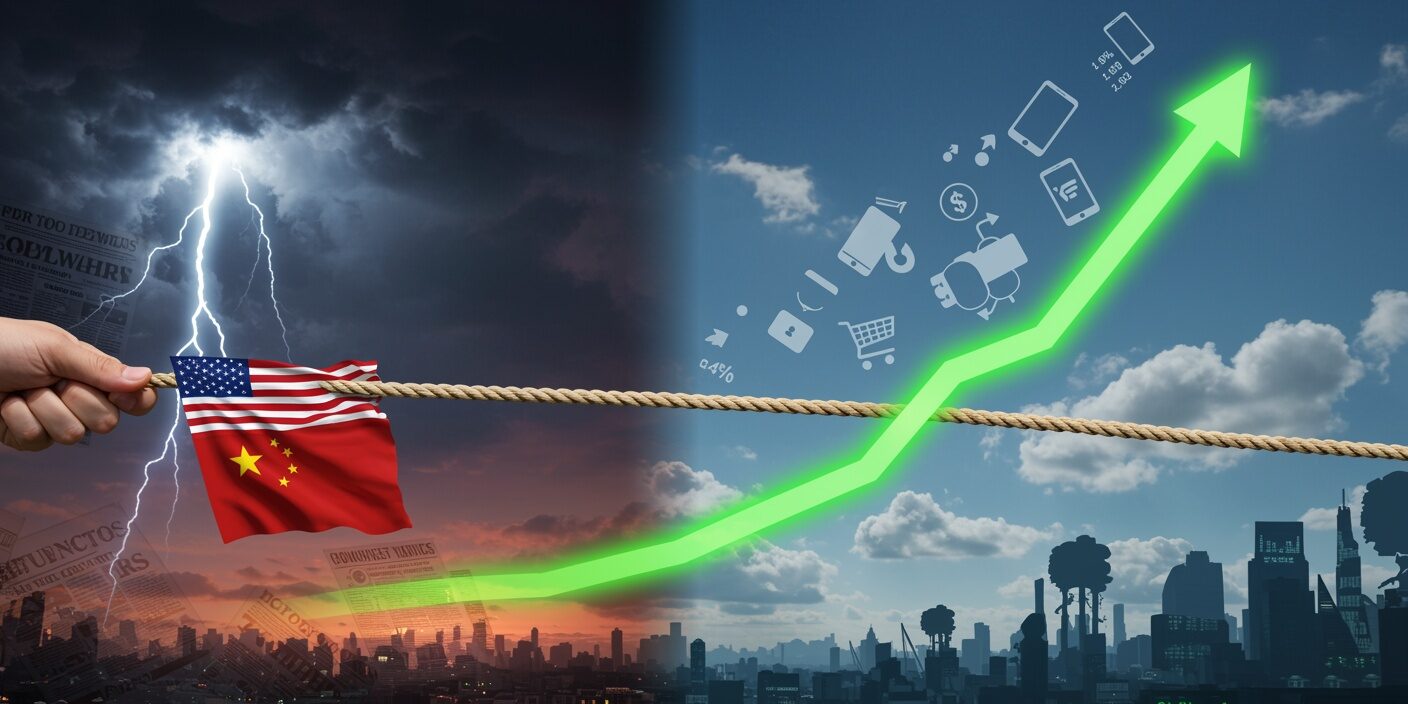
Markets continued and accelerated their climb this week as US President Donald Trump backed down on some of his more extreme tariff proposals against China. Investors cheered a de-escalation in the heated trade war rhetoric between the two countries, with them agreeing to a 90-day tariff pause for further negotiation.
US duties on Chinese products will now fall to 30%, while China’s tariffs on US goods will drop to 10%. On Monday, the S&P 500 jumped nearly 4%, with the tech-heavy Nasdaq composite leaping even higher, buoyed by renewed confidence in the sector most affected by the US-China technology dispute.
The rally extended into Tuesday, lifting markets close to the record highs reached earlier this year. The momentum continued throughout the week, with Nasdaq and S&P 500 trading 6.6% and 4.5% up, respectively, for the week, as at the time of writing. This was even as investors digested weaker retail sales and inflation data for clues to the health of the economy.
While the ceasefire in the US-China trade war is welcome, difficult negotiations are set to continue, while tensions persist. Tariffs have been paused or lowered, but they remain significantly higher than pre-Trump levels, and their impact on inflation and growth is still playing out.
Despite a thawing of US-China relations and a trade deal with the UK, Trump is still at loggerheads with many key US trading partners. Just this week, he returned to his recurring complaint that the European Union is “very nasty” and railed at Apple CEO Tim Cook for making iPhones in India, raising fears of further disruptive trade disputes ahead.
While the tech and consumer sectors are enjoying a short-term lift, longer-term concerns about supply chains, input costs, and geopolitical instability remain. Analysts warn that markets may not be fully pricing in these effects, which are starting to filter into earnings reports.
Walmart, for instance, has said it will raise prices on some items due to tariffs. Products such as bananas, avocados, roses, and toys are among those facing increased costs. According to FactSet, corporate executives uttered the word “uncertainty” in 87% of earnings calls this season, compared with 38% in the previous three months.
Executives used “tariffs” in 93% of earnings calls. “Recession” came up in 30% of these discussions, versus 3% in the previous quarter. Meanwhile, a Bloomberg poll of economists has put the chances of a recession next year at almost 50/50, hinting at turbulence ahead.
The sharp equities recovery has caught some investors off guard, particularly those who had reduced their equity exposure in the belief that the tariff war could only result in a downward trajectory for markets. In contrast, our major global equity components have gained between 11.5% and 18.4% since the 8 April trough.
This vindicates our strategy for fully invested clients to stay the course. For those with offshore cash, we advocate a cautious, incremental investment in equity markets, whereas we are comfortable for our South African clients to commence converting rands into dollars at an exchange rate of circa R18/$.
Although de-escalation has improved investor sentiment this week, the underlying issues driving the trade war – trade imbalances – have not gone away. While the various tariff de-escalations and pauses are welcome by businesses, the respite has not removed uncertainty. Consequently, volatility is likely to persist for the entire presidential term, with inflation, interest rates and corporate earnings set to be key factors determining performance in the months to come.
“Between an uncontrolled escalation and passivity, there is a demanding road of responsibility that we must follow.”
– Dominique de Villepin, former French Prime Minister
“We’re very pleased and appreciative of the progress that has been made by the administration to bring tariffs down… but let me emphasise we still think that’s too high.”
– John David Rainey.Walmart’s Chief Financial Officer
Global News
- The US and China slashed sweeping tariffs on each other’s goods for 90 days on Wednesday after the countries reached a deal in Geneva over the weekend. The US will temporarily lower its overall tariffs on Chinese goods from 145% to 30%, while China will cut its levies on American imports from 125% to 10%. This 90-day truce has been seen as a strategic win for Chinese President Xi Jinping, who maintained a firm stance during the escalating trade tensions. While Trump hailed the agreement as a “total reset,” Chinese officials remain cautious, viewing the pause as a reprieve rather than a resolution. Analysts warn that the relief may reduce Beijing’s impetus for economic reforms, and the underlying issues in the trade dispute remain unresolved. The temporary de-escalation has provided a boost to global markets, but uncertainties linger as both nations prepare for further negotiations.
- Wall Street gained on Monday after the US and Beijing brokered an agreement to substantially, although temporarily, lower tariffs for 90 days, continuing their gains on Tuesday. As of yesterday, the S&P 500 had risen for a fourth straight day, while the dollar dropped against most major currencies. Gold prices fell to a more than one-month low yesterday, as easing tensions between the US and China reduced demand for the metal’s safe-haven appeal. Spot gold declined by 0.8% to $3,153.09 per ounce. Market expectations for interest rate cuts have shifted, with the first anticipated in October rather than July. Gold, which typically benefits from lower interest rates, may face additional pressure if economic optimism continues to rise.
- The temporary deal between the US and China has alleviated immediate recession fears with major financial institutions like JPMorgan and Barclays adjusting their forecasts, lowering recession probabilities, and boosting economic growth projections. However, JP Morgan CEO Jamie Dimon warns that a recession is still a probability, and analysts caution that the underlying economic challenges persist. Effective tariff rates, averaging 17.8%, remain elevated, and inflation pressures continue to threaten consumer spending and business investment. While the truce offers temporary relief, uncertainties in trade policy and inflation trends continue to pose risks to the US economy.
- During his visit to Saudi Arabia this week, Trump signalled a shift in US foreign policy towards prioritising economic partnerships over traditional human rights advocacy. He announced a $142 billion arms deal with the Kingdom, part of a broader $600 billion investment package aimed at bolstering US industries such as defence, energy, and technology. Trump also revealed plans to lift sanctions on Syria, encouraging its new leadership to normalise relations with Israel and assist in countering ISIS. Additionally, he urged Iran to engage in nuclear negotiations, warning of intensified sanctions otherwise. These moves reflect Trump’s pragmatic approach to Middle East diplomacy, focusing on economic growth and regional stability over democratic reforms.
- Trump was joined at lunch in Saudi Arabia on Tuesday by numerous business leaders from some of America’s largest companies, including Nvidia, Alphabet, Amazon.com, and Elon Musk. They want to secure business opportunities from Saudi investors, businesses, and government departments, as well as address Trump’s tariffs. Agreements with the US, expected to be announced soon, will enable Saudi Arabia and the United Arab Emirates to gain greater access to advanced AI chips from Nvidia and AMD. Technology shares rose broadly in anticipation of eased restrictions on exports of advanced AI chips. Nvidia climbed 5.6% while AMD surged 4% on Tuesday, and both companies extended those gains in Wednesday trading.
- Oil prices fell more than $1 during trade yesterday, with Brent crude futures dropping 2.3%, on the expectation of a potential US-Iran nuclear deal, while a surprise build in US crude oil inventories last week heightened investor concerns about oversupply. Iran was willing to agree to a deal with the US in exchange for the lifting of economic sanctions, an Iranian official told NBC News on Wednesday. Saudi Arabia fully supported the US-Iran nuclear talks and hoped for positive results, the kingdom’s foreign minister, Prince Faisal bin Farhan Al-Saud, said on Wednesday.
- Indian and Pakistani military leaders held talks on Monday intended to extend a tenuous cease-fire that has halted the most expansive fighting in decades between the two nuclear-armed states. Two days after a US-mediated truce, a sense of normalcy began to return to both countries. Stock markets in both countries jumped on the first day of trading since the agreement was reached.
- US inflation unexpectedly slowed to its lowest rate in more than four years amid tame prices for clothing and new cars, even as Trump’s tariffs are expected to cause prices to rise. The slower gain in the pace of the cost of living indicates that companies aren’t acting with urgency to pass along the cost of higher tariffs to consumers. Consumer prices rose 0.2% last month, bringing the annual inflation rate to 2.3% versus 2.4% in March, according to the latest Consumer Price Index data released on Tuesday by the Bureau of Labor Statistics. It’s the lowest annual rate since February 2021. Economists had expected a 0.3% gain month-on-month.
- Growth in US retail sales decelerated notably in April, reflecting that consumers had pulled back spending on cars, sporting goods, and other categories of imported goods amid concerns about rising prices from tariffs. The value of retail purchases, not adjusted for inflation, increased 0.1%, Commerce Department data showed yesterday. That followed a revised 1.7% gain in March, which was the largest in two years.
- US factory production declined by 0.4% in April, marking the first decrease in six months, primarily due to a 1.9% drop in motor vehicle and parts production as automakers adjusted to ongoing tariff pressures. Despite a 1.2% year-on-year increase in factory output, the manufacturing sector faces challenges from shifting trade policies, including a 10% tariff on most imports and a 25% tax on steel, aluminum, and motor vehicles. These tariffs aim to support the US industrial base, but economists caution that high domestic production and labour costs make it difficult to bring back overseas factories. Overall industrial production remained flat, with capacity utilisation dipping to 77.7%, indicating underused industrial resources.
- UK total retail sales rose by 7% year-on-year in April 2025, rebounding strongly from a 4% decline in April 2024. The rise was boosted by the Easter holiday falling in April this year, distorting comparisons but pushing growth above the three- and twelve-month averages. Sunny weather also prompted strong consumer spending across the board, while consumers refreshed wardrobes, data from the Office for National Statistics showed yesterday.
- The UK’s job market has continued to weaken, although those who are employed saw salaries rise faster than inflation. The unemployment rate increased to 4.5% in the January to March period, up from 4.4% in the preceding quarter, according to the latest figures from the Office for National Statistics (ONS). In addition, job vacancies again dropped. The ONS figures also showed that pay is still rising faster than the rate of inflation. Regular earnings, which exclude bonuses, grew at an annual pace of 5.6% in the first three months of the year.
- Qatar signed an agreement on Wednesday to purchase 160 jets from US manufacturer Boeing for Qatar Airways. The deal was signed by both Trump and Qatar’s Emir Sheikh Tamim bin Hamad Al-Thani during Trump’s visit to the Gulf Arab country. Trump said the deal was worth $200 billion and included 160 jets. The Trump administration appears to be seeking Boeing order commitments as part of its negotiating strategy on trade. Boeing’s stock rose 1.7% on Wednesday.
- Trump said he plans to order a cut in US prescription drug costs to bring them in line with other countries, causing a decline in pharmaceutical shares worldwide. He has vowed to sign an executive order mandating that Americans pay no more than people in countries that have the lowest price and promising a 30% to 80% cut. Shares in US drugmakers dropped before the official open on trading in New York, European drugmakers slid, while the pharmaceuticals subgroup in Japan’s Topix Index posted its biggest one-day loss since August. Details of the price cuts have yet to be provided.
- Since returning to office, Trump and his family have seen a surge in profits, with over $2 billion flowing into Trump-affiliated ventures over the past month. These include investments in real estate, the $TRUMP cryptocurrency, and a private Washington club with a $500,000 membership fee. Foreign governments such as Qatar, the UAE, Saudi Arabia, and Serbia have poured billions into Trump-branded developments, prompting concerns over potential conflicts of interest, despite White House assurances that his sons now run the businesses. Major deals include Qatar funding a $5.5 billion golf resort, Saudi-backed hotel projects in Dubai and Oman, Jared Kushner’s $1 billion hotel venture in Belgrade, and Qatar’s proposed $400 million donation of a presidential aircraft. Meanwhile, the Trump-branded cryptocurrency, marketed with perks like White House tours, has attracted millions, while ventures like LIV Golf and major Republican events continue to funnel wealth to the Trump family, further blurring the lines between public office and personal gain.
- Microsoft is laying off 3% of its workforce, or roughly 6,000 employees, it said on Tuesday as it cuts management layers. This comes as the technology giant looks to rein in costs while funneling billions of dollars into its ambitious bet on AI. The cuts will be across all geographies and are likely the largest since Microsoft laid off 10,000 employees in 2023. According to a state filing on Tuesday, about 2,000 workers will be impacted at Microsoft’s headquarters in Redmond, Washington. The terminations are expected to commence on 13 July. Microsoft had 228,000 employees worldwide as of last June.
- Trump has asked Apple CEO Tim Cook to stop building plants in India, taking aim at the iPhone maker’s plans to diversify its manufacturing beyond China. Instead, Trump wants Apple to manufacture in the US, where it has no smartphone production. This will adversely impact Apple’s plan to import most of the iPhones it sells in the US from India by the end of next year, accelerating a shift beyond China to mitigate risks related to tariffs and geopolitical tensions.
- Tencent Holdings’ stockpiles of AI chips should protect it from US restrictions, it said on Wednesday, after it reported first-quarter results that beat expectations. Tencent reported revenue of up 13% for the quarter to end-March, its fastest pace in more than three years, bolstering investors’ hopes that it will weather a potential global downturn in 2025. However, Tencent operates extensive cloud, advertising, and fintech services, which are susceptible to economic shocks and a decrease in domestic consumption. Its shares have risen 25% in 2025. Shares in its major backer, Prosus, increased 4.2% in Europe.
- Luxury goods company Burberry aims to trim 18% of its global workforce by 2027 as it looks for ways to cut costs and revive its ailing business. On Wednesday, it reported a $4 million loss during its latest financial year. Revenue also fell sharply in the 12 months to March 29, the company said in its preliminary results. By the 2027 financial year, Burberry said, it hopes to unlock $133 million in annual savings. Burberry’s stock jumped more than 9% on Wednesday morning following the results. Its stock has slumped 66% since an all-time high hit in April 2023.
- Walmart has cautioned that new tariffs will lead to price hikes for consumers as early as this month. In its latest quarterly report, the company posted a 4.5% increase in sales at US stores open for at least a year but noted a slowdown in transaction growth compared to last year. While grocery and pharmacy sales remained steady, general merchandise struggled. Following the report, Walmart’s shares dropped 4% in morning trading – their steepest intraday fall in about a month. Despite this, the stock was up 7.2% for the year as of Wednesday, outperforming the relatively flat S&P 500 Index.
- As Warren Buffett prepares to step down from the helm of conglomerate Berkshire Hathaway at 95, he has become known as the doyen of capitalism, investing in the country’s growth with integrity, optimism, and common sense. Buffett was the company’s CEO and Chairman and is the largest single shareholder with a 30% stake. Bloomberg’s Billionaire Index ranks him as the seventh richest person globally, with $160 billion. This year, his fortune grew by over $1 billion. Buffett has followed five financial rules: investing long-term, staying informed, holding a competitive advantage, focusing on quality, and managing risk.
- As at Thursday’s close the S&P 500 was 4.5% up for the week.
Local News
- President Cyril Ramaphosa and Trump, will hold a high-level in-person meeting in Washington next week to restore diplomatic and trade relations between the two countries. According to sources, the two are expected to discuss a range of diplomatic and trade relations, including the arrival of 49 Afrikaners fleeing racial persecution this past Monday, and set the stage for a series of bilateral trade agreements in various sectors, including agriculture, energy, and transport. Electricity Minister Kgosientsho Ramokgopa’s office has confirmed that increased gas co-operation with the US was a key component of the offer being formulated for Trump. This comes on the back of reports that the US was set to ban its agencies from all work regarding the G20 in South Africa, a situation of which the South African government was not aware.
- Busisiwe Mavuso, CEO of Business Leadership South Africa (BLSA), says that the country’s relationship with the US is economically vital. Writing for BusinessLIVE, she noted that navigating this relationship involves balancing the need to protect economic benefits while reducing overdependence by strengthening ties with other global partners. According to a small poll among members of BLSA, 92.9% believe that restoring ties with the US is crucial for growth; of these, 71.4% agree that pursuing new markets is equally urgent.
- The Bureau for Economic Research (BER) at Stellenbosch University downgraded its real GDP forecast from 2% to 1.5% in 2025 over mounting political instability and unresolved global economic risks such as US tariffs. Between 2027 and 2030, the BER expects growth to average just 1.6%. Some economists at BER are questioning whether South Africa has become a 1% growth economy, a level it has struggled to break through for more than 15 years.
- The DA is optimistic that talks with the ANC are heading in the right direction ahead of Finance Minister Enoch Godongwana’s presentation of the third National Budget on 21 May, following a meeting between Government of National Unity leaders to discuss the National Budget. The parties have agreed that a VAT increase won’t happen, and Godongwana will need to balance raising extra revenue, cutting spending, and increasing investment. Cabinet approved the submission of the new Budget yesterday.
- The South African Revenue Service plans to recruit at least 500 new employees to pursue outstanding tax revenue, according to sources. The initiative, which reportedly goes by the name of “Project AmaBillions,” aims to recover at least R70 billion in tax revenue. It will target “low-hanging fruit” such as undisputed tax debt. It is believed that outstanding taxes owed to the revenue service currently amount to around R300 billion. After having removed the VAT proposal from the National Budget, the fiscus has a R75 billion hole to fill.
- The South African Reserve Bank and National Treasury are “working very hard to establish the appropriate inflation framework,” and an announcement would be made “very soon,” David Masondo said yesterday at an investor conference in Cape Town. The rand spiked on the news, gaining as much as 1.1%, leading emerging-market currency gains and its best intraday level – at R18.06 – since 18 March. The currency’s strength came as expectations that a lower inflation target would keep monetary policy tighter, holding off on interest rate cuts for longer to put a brake on price increases.
- However, the Bank of America (BofA) has revised its monetary policy outlook and now expects two more interest rate cuts this year following a recent research trip to the country. The bank anticipates the South African Reserve Bank reducing the repo rate on 29 May and 31 July and sees the policy rate at 7% by the end of July. It is retaining its 1.2% GDP growth forecast as it keeps an eye on fiscal risks beyond 21 May, when the budget will be released.
- The Department of Trade, Industry, and Competition and the broad-based BEE (B-BBEE) Commission are planning amendments to legislation to give the commission greater enforcement powers because of poor compliance. The only measure at the commission’s disposal at the moment is to rely on the courts to enforce the law, although none of the commission’s more than 50 referrals had made it that far. A dedicated B-BBEE tribunal and administrative sanctions for the failure to submit reports on B-BBEE compliance is required, which would require a review of the legislation.
- Ramokgopa on Wednesday apologised for the return to load shedding on Tuesday. Ramokgopa said the outages, now at 2023 levels, were due to the delayed return of generation units and unplanned breakdowns and that management would be held accountable for the situation. He added that Eskom had to engage with the equipment suppliers to ensure better planning and management of their contributions. The relapse came after only 13 days of load-shedding last year.
- Health Minister Aaron Motsoaledi said yesterday at a media briefing in Pretoria that the HIV/Aids programme is not at risk of collapsing after the US withdrew Pepfar aid, dismissing the “narrative” of some health experts and activists who have criticised the Health Department’s response in recent months. He said the Department of Health was taking steps to address the loss of aid, including new training programmes for health workers and meetings with potential donors. However, 8,061 people who were working in US-funded programmes are now without jobs.
- Redirecting the medical scheme contributions of public servants to the National Health Insurance fund will need careful management as it will require changing their conditions of service, delegates at the annual Board of Healthcare Funders (BHF) conference heard on Tuesday. Any changes proposed to the generous medical scheme benefits provided to civil servants will likely be opposed, as they are a prominent feature in wage negotiations. The state’s increase is more generous than those typically accorded by private sector employers. The BHF is an industry association for medical schemes and administrators.
- The latest DebtBusters’ Debt Index for the first quarter of the year, released on Tuesday, showed that more South Africans than ever are using personal loans to make up the shortfall between income and the rising cost of living. This is despite South Africans having access to some of their retirement savings in the form of the “two-pot” retirement regime. Households earning between R10,000 and R35,000 a month are cutting back on essential spending, including on vehicle loans, utilities, transport and food to survive. Over the past nine years, electricity tariffs have increased by 135%, the price of petrol has risen by 88%, and the compound effect of inflation is 52%, DebtBusters pointed out.
- Stocks on the JSE defied disheartening local employment figures and rallied to a fresh record high on Wednesday, surging past the 93,000-point mark as the easing tensions between the US and China also buoyed global markets.
- The Public Investment Corporation (PIC) said on Monday that it was considering various options to stabilise embattled state-funded poultry producer, Daybreak Foods. Over the weekend, the PIC allocated a requested further R74 million to Daybreak, initially earmarked for capital expenditure, to address the company’s immediate liquidity needs, such as April salaries and feed supplies. Workers have formally requested a forensic investigation into the company’s affairs. The DA has called on the Financial Sector Conduct Authority to launch an immediate probe into the PIC’s role and oversight failures at the company.
- De Beers has been quietly selling rough diamonds at sharply marked-down prices to a handful of customers to reduce ballooning inventories without openly cutting prices. This is a highly unusual move that’s fuelling tensions across an industry already mired in crisis. In recent months, De Beers has sold hundreds of millions of dollars of rough diamonds through side deals with a small number of its customers, according to buyers who asked not to be identified discussing private information. The company has been selling the stones at a 10% to 20% discount to its set prices, the people said.
- European investor Greencoat Renewables said on Tuesday it was seeking a secondary listing on the JSE, creating a new vehicle for investors to capitalise on Europe’s green energy boom. As the first JSE-listed company with an entirely offshore portfolio of renewable energy assets, local shareholders can now invest directly in European renewable energy infrastructure. Asset manager Schroders estimates that global investment worth $28 trillion in renewable infrastructure is needed over the next three decades, and more than double that is needed to reach net-zero emissions by 2050.
- Africa’s largest mobile network operator, MTN, reported solid growth on Monday as revenue gained 19.8%, when stripping out currency fluctuations, for the three months to March. The JSE-listed company, which has just shy of 300 million customers in 16 markets, pointed to a growing subscriber base, a 28.7% gain in data revenue, as well as a 25.2% increase in fintech income as the backbone behind its “strong operational execution”. The company invested R7.5 billion in capital expenses into networks and platforms during the quarter.
- Technology group Altron expects its full-year earnings from continuing operations to be as much as 75% higher, it said on Tuesday. Altron has been under pressure to expand units such as Netstar, which has lost ground to competitors such as Mix Telematics and Karooooo-owned Cartrack. Altron will release its annual results on 26 May. Bytes Technology Group, which was spun out of Altron several years ago, reported a 16.5% rise in headline earnings per share for the year to end-February, it said on Tuesday. Bytes is banking on its relationship with large international software vendors to carry its business for the coming year.
- As at the time of writing, the rand was 0.7% stronger against the dollar, and the ALSI was 0.6% up for the week.
Sources: Dynasty, IOL, Business Report, BusinessLIVE, CNN, Bloomberg, AFP, Daily Maverick, CNBC, NYT, Reuters, Sky News, etc.