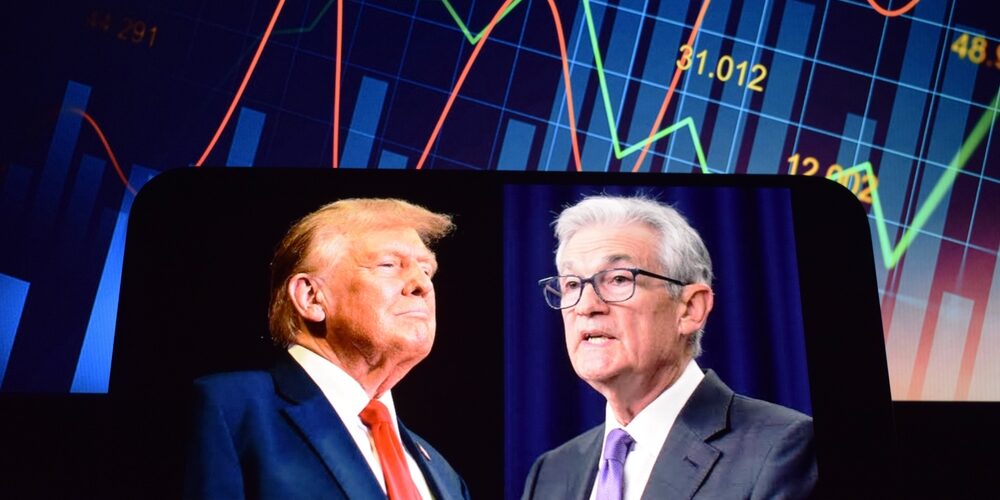
Markets are on tenterhooks as they await the US Federal Reserve’s September interest rate decision. On the one hand, equities have been primed for a rate cut as deep as 50bps based on economic signals such as a slowing labour market. On the other hand, hotter-than-expected wholesale inflation suggests that this is not a foregone conclusion.
The debate came into sharper relief this week as markets await Fed Chairman Jerome Powell’s speech at the Jackson Hole economic conference. At last year’s Jackson Hole summit, Powell indicated that the Fed was ready to begin cutting interest rates. Many market participants are now hoping for a clearer view of the Fed’s direction from this year’s conference. The speech is framed as an “Economic Outlook and Framework Review,” indicating Powell will give his views on broad conditions as well as discuss the Fed’s long-term policy goals.
Powell’s Jackson Hole speech had yet to be delivered at the time of writing. However, it is significant that he has remained fiercely independent in the face of intensified attacks from US President Donald Trump. Trump believes that Powell is moving too slowly on cutting interest rates to support the economy.
Minutes from the Fed’s July meeting released this week underscore how delicate the Fed’s balancing act has become. While most Fed officials judged inflation a bigger threat than unemployment, two dissented in favour of an immediate cut. One was Vice Chairman, Michelle Bowman, who is a possible candidate to replace Powell when his term ends in May 2026.
Whatever comes out of the Jackson Hole speech and September’s interest rate decision, markets look vulnerable to disappointment. With indices trading near record highs, equities may have priced in much of the anticipated easing. A 25bp move may fall short of expectations for a 50bp cut.
This week’s cautious drift lower in stocks reflects both rate-cut uncertainty and growing investor scepticism over whether AI-driven earnings growth can sustain current valuations. A firmer dollar this week suggests some traders are moderating expectations for interest rate cuts in September. But beyond immediate interest rate decisions, markets will increasingly start to weigh up what comes after Powell steps down.
Faith in the Fed’s independence is one of the major reasons that investors have so much trust in the US dollar as the world’s reserve currency and American equities markets. Continued political interference and fears that the independence of the Fed is being eroded could undermine confidence in monetary policy and in US asset markets more broadly.
Powell’s Jackson Hole remarks and economic data leading up to the Fed interest rate decision in September are likely to affect short-term sentiment. In the longer term, the substance and appearance of the Fed’s independence will be key. Signs that the Fed’s independence is compromised could have ramifications beyond the timing of rate cuts.
“Participants generally pointed to risks to both sides of the Committee’s dual mandate, emphasising upside risk to inflation and downside risk to employment.”
– Fed meeting minutes from July
“Inflation is the risk that’s on our doorstep, much more so than the labour market. Fed officials know that.”
– Lauren Saidel-Baker, economist at ITR Economics
Global News
- Fed Chairman Jerome Powell will unveil a new policy framework today at the central bank meeting in Jackson Hole to adjust the central bank’s approach to the current economic environment. The update will replace the Fed’s 2020 strategy, which focused on “broad-based and inclusive” employment gains and avoided pre-emptive action on inflation. Central bankers are attending the meeting to support Powell amid mounting criticism from Trump over his refusal to cut interest rates, criticism that has unsettled policymakers globally and raised concerns about the potential weakening of central-bank independence.
- Trump’s repeated calls for rate cuts have sparked debate over fiscal dominance. Some investors argue it is looming but has not yet pushed borrowing costs to unsustainable levels, while others say it is already evident as long-term yields remain high despite expected Fed easing. The Fed, under pressure, is expected to cut rates at its 16 to 17 September meeting. The US last faced fiscal dominance – defined as government spending and taxation significantly impacting its monetary policy – during WWII, when low rates financed war debt until surging inflation led to the 1951 accord restoring Fed independence.
- Minutes of the Fed’s 29 to 30 July meeting released on Wednesday showed that the 18 policymakers noted both higher inflation and weaker employment, but most said inflation posed the greater risk. The statement described the labour market as “solid” though inflation was “somewhat elevated”. Governors Christopher Waller and Michelle Bowman dissented, citing concerns over the weakening job market. The Fed left interest rates unchanged in a range of 4.25% to 4.5%, citing uncertainty as economic activity slowed in the first half of the year.
- The Nasdaq and S&P 500 edged lower this week as investors slightly pulled back from tech stocks, which had led much of the rebound from April’s selloff, amid cooling AI enthusiasm and caution ahead of remarks from Fed officials at the Jackson Hole symposium. The shift saw money move into less highly valued sectors, tempering momentum after a strong summer rally.
- S&P Global Ratings said on Tuesday that revenue from Trump’s tariffs will help offset the fiscal impact of his tax cuts. The agency affirmed its US rating, unchanged since a 2011 downgrade from the highest level, and maintained a stable long-term outlook. Treasury yields rose while the dollar was little changed on the news. Tariff revenue hit a record $28 billion in July, the highest monthly customs take on record. Treasury Secretary Scott Bessent told CNBC’s Squawk Box the funds will be used to reduce national debt.
- S&P Global Ratings said on Tuesday that US public retirement funds are set to outperform typical expectations, with pensions projected to generate 11% to 12% returns for the fiscal year to June, driven by strong stock market gains despite a sharp April dip linked to Trump’s tariff plans. This follows estimated returns of 16% to 17% in 2024. S&P noted that pension managers typically plan for at least 7% to maintain funding ratios and raised its discount rate guideline to 6.5%, citing continued market gains supported by technologies like artificial intelligence and private equity.
- The tariff war is accelerating China’s trade and investment expansion into the Global South; S&P Global research showed on Tuesday. Over the past decade, China’s exports to Southeast Asia, Latin America, and the Middle East have doubled, far outpacing growth to the US and Western Europe. Trade with its 20 largest Global South partners now accounts for around 20% of those countries’ GDP, and more than half of China’s total trade surplus is with the region, compared with 36% for the US and 23% for Western Europe.
- Russia expects India to keep buying its discounted oil despite US tariffs and criticism, with imports now making up nearly 37% of India’s crude. New Delhi says the purchases are essential to curb inflation, rejecting Washington’s claim that it is “profiteering” from sanctioned oil. As the US threatens higher duties, India is deepening ties with Russia and China, while Moscow offers to take more Indian exports and expand cooperation in trade and technology. Chinese refineries have secured at least 15 cargoes of Russian crude for October and November, diverting supplies that would typically go to India, analysts said on Wednesday.
- The US and EU advanced their trade pact on Thursday with a joint statement outlining tariff cuts and cooperation measures. Under the deal, US duties on European autos would drop from 27.5% to 15% once the EU passes legislation reducing tariffs on US industrial goods and expanding market access for American farm and seafood products. The agreement also extends relief to pharmaceuticals, semiconductors, and aircraft, while considering quotas for discounted steel and aluminium. Both sides pledged to cooperate on supply chains, food standards, and digital trade, though alcohol tariffs, digital services rules, and Europe’s commitments on US investments and energy purchases remain unresolved.
- British inflation hit its highest in 18 months in July when it increased to 3.8% from 3.6%, official data showed on Wednesday, once again leaving the country with the fastest rate of price increases among the world’s largest rich economies. Inflation in Britain’s services sector, which is watched closely by the Bank of England, accelerated to 5.0% from 4.7% a month earlier. The central bank expected headline inflation to rise to 3.8% in July but had forecast a smaller 4.9% rise in services prices. Economists polled by Reuters had mostly expected increases of 3.7% and 4.8% respectively.
- Meta Platforms is reorganising its AI operations again, splitting its newly formed AI group into four teams and reassigning many existing AI employees to better leverage recently acquired talent. The reorganisation, outlined in an internal memo sent on Tuesday from Chief AI Officer Alexandr Wang, aims to “accelerate” Meta’s pursuit of superintelligence. Layoffs are not part of the reorganisation, according to sources. The company also signed a deal worth at least $10 billion with Alphabet’s Google for cloud computing services as part of its spending spree on AI, according to sources.
- Nvidia is developing a new AI chip for China that will be more powerful than the model it is currently allowed to sell there, according to sources. The new chip’s specifications are not completely finalised, but Nvidia hopes to deliver samples to Chinese clients for testing as early as next month. Last week, Trump suggested more advanced Nvidia chips might be sold in China. US regulatory approval is far from certain due to longstanding concerns in Washington about giving China greater access to American AI technology.
- Shares of Novo Nordisk rose as much as 5% after its weight-loss drug Wegovy received US approval last Friday to treat a serious form of liver disease, giving the company an edge over rival Eli Lilly & Company in the US market. It is also slashing the cost of Ozempic by 50% for cash-paying patients, it said on Monday. After starting the year as Europe’s most valuable traded company, Novo has lost about half its value amid US obesity market competition. Meanwhile, Eli Lilly & Co. is raising the list price for its obesity shot in the UK by as much as 170%, as the pharma industry comes under pressure from Trump to increase medicine prices in Europe and lower them for Americans.
- Anheuser-Busch InBev said on Tuesday that it would invest $15 million in its US brewery as Trump pushed to boost domestic production. This move is part of Anheuser-Busch’s $300 million investment announced in May to create and sustain manufacturing jobs in the US this year.
- As at Thursday’s close, the S&P 500 was 1.2% down for the week.
Local News
- The ANC could face its most severe defeat yet in the next local government elections if it fails to address the cost-of-living crisis and service-delivery backlogs. According to the DA’s polling, which has previously proven accurate, the ANC would get a maximum of 20% in Johannesburg if elections were held now, and the DA could become the top party there. In Cape Town, the PA is also gaining support, potentially winning at least 8% of the vote, while in eThekwini the MK party may lose around 5%, possibly allowing the IFP and DA to emerge as the top parties in KwaZulu-Natal.
- President Cyril Ramaphosa yesterday called for lower export duties on South African goods to Japan, while speaking at the Tokyo International Conference for African Development. He said fairer market access was critical as African countries face rising trade barriers from the US. Ramaphosa urged Japan to support tariff co-operation, noting South Africa’s position as a leading exporter of agricultural produce and industrial products such as vehicles and components.
- South Africa exported R65.5 billion in agricultural produce in the second quarter, up 10% from a year earlier, as producers likely ramped up shipments ahead of US tariffs that took effect this month. Agbiz chief economist Wandile Sihlobo said last Friday that some exporters may have taken advantage of the 90-day pause on higher tariffs. The increase, mainly in citrus, wine, fruit juices, and nuts, was also supported by a strong local fruit harvest and far exceeded the typical 9% quarterly growth to the US.
- Economic recovery is expected to have continued at a modest pace in the second quarter, with real GDP growth seen accelerating slightly after a tepid 0.1% rise in the first quarter. Professor Raymond Parsons of the North West University Business School told BusinessLIVE last Friday that some sectors show promise while others lag. He estimates second-quarter growth at 0.3%, contributing to a full-year 2025 forecast of just 0.9%, yet well below the government’s medium-term target of 3%.
- Salaried earners took another knock in July, as average take-home pay continued its months-long downward trend and cost-of-living pressures mounted, particularly from sharply higher municipal service tariffs. According to the latest BankservAfrica Take-home Pay Index released on Wednesday, nominal pay slid for the fifth consecutive month, although still higher than a year earlier. The data showed that there may have been job cuts at the higher end of the range of between R40,000 and R100,000 a month. This comes as DebtBusters said in its second-quarter Debt Index that the amount of money people pay towards debt is at its highest level since 2017.
- The Competition Commission has asked the Constitutional Court to revive a decade-old rand-rigging case, arguing it caused lasting harm, weakened the currency, and impacted trade worth about R35 trillion. On Tuesday, the commission said it seeks to reinstate charges against 17 banks, in addition to the four global institutions, BNP Paribas, JPMorgan, HSBC, and Credit Suisse, that the Competition Appeal Court previously ruled could face prosecution. Lawyers for the international banks contend the case cannot be reopened, arguing the commission forfeited its right to challenge jurisdiction by failing to appeal the earlier ruling on geographical limits. The hearings ended yesterday.
- Investec South Africa announced a share purchase and buyback programme of up to R2.5 billion on Wednesday, joining other top JSE-listed firms in repurchasing securities. The group will acquire ordinary shares in its London unit and repurchase Investec Limited (South Africa) ordinary shares through the end of March. The bank first announced the buyback plans in May, following its previous 18-month programme launched at the end of 2022, which cost R7 billion.
- Naspers said yesterday that efforts to unlock value in its portfolio outside Tencent are paying off, narrowing the gap between Tencent’s market value and its output as it has created more than R200 billion in value in the past year. Naspers also said its subsidiary Prosus doubled the number of AI agents working alongside its employees in July. In a letter to shareholders at the Prosus AGM on Tuesday, CEO Fabricio Bloisi highlighted a strong first-quarter performance and rising share price, saying Prosus is “building something truly special”. This comes as Prosus has been trading at all-time highs in July and August.
- Blue Label Telecoms shares jumped more than 7% on the JSE yesterday after it said it expected to report sharply higher annual earnings and as engagements on its proposed restructuring continue. Earnings per share are expected to be 279% to 283% higher. On the same day, the Competition Tribunal approved its move to acquire a Cell C unit as it continues with its plan to take over the company. The company’s shares are among the best performers on the JSE so far this year, with a gain of about 192%. Blue Label is Cell C’s largest shareholder and could list Cell C separately after all regulatory requirements are completed.
- Spur says it is facing growing competition from supermarkets as Checkers, Woolworths, and other retailers aggressively expand their ready meals and fresh food ranges, which are eating into its customer base. It said yesterday it will continue to expand its takeaway and delivery offerings, but its defence against the supermarket threat rests on reinforcing its identity as a sit-down, family model. Spur is also overhauling its restaurant network to enforce that strategy. Shares rose as much as 13.8% yesterday after it reported headline earnings per share, a key financial metric, up 16.8%.
- As at the time of writing, the rand was 0.2% weaker against the dollar, and the ALSI was 0.25% up for the week.
Sources: Dynasty, Bloomberg, Reuters, BusinessLIVE, CNN, Business Report, Daily Maverick, NYT, WSJ, IOL Business, ITWeb, TechCentral, News24, Daily Investor, etc.